What's Inside
- Can This Upright Juniper Become a Cascade?
- Check Vigor, Flexibility, and Root Anchorage
- Choose the Cascade Line Before Cutting
- Protect and Wire the Trunk
- Lower the Trunk in Small Stages
- Support Recovery and Watch the Wire
- Leave the First Bend Supported
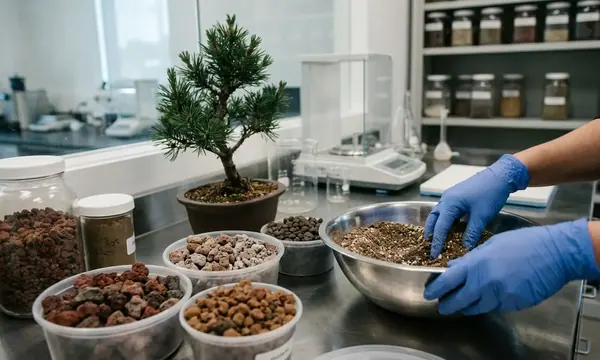
An upright nursery Juniperus procumbens, commonly sold as ‘Nana’, can provide the starting structure for a cascade bonsai. Its spreading habit suits a descending composition, but the first styling must respect the trunk’s existing flexibility. The steps ahead cover stock assessment, staged bending, and the cultivation & care that supports recovery.
Can This Upright Juniper Become a Cascade?
Can this upright procumbens juniper be bent below its pot without splitting the trunk?
The answer rests on four connected conditions: tree vigor, trunk flexibility, root anchorage, and the severity of the proposed bend. Wire can hold a pliable trunk in position; increasing its thickness cannot make brittle wood tolerate a tighter curve.
Set the visual destination before handling the trunk. A full cascade carries its lowest trunk or foliage below the pot base. A semi-cascade descends below the rim while finishing above the base. The latter can be a sound first-stage result, even when the eventual design calls for a deeper descent.
Check Vigor, Flexibility, and Root Anchorage
A nursery juniper with extending green tips, a firm root ball, and gentle natural trunk movement offers a workable starting point. Inspect it from foliage to roots before testing the wood.
- Look for healthy foliage and active extension appropriate to local conditions. Check for widespread browning, stippling, webbing, or scale insects.
- Lightly move the trunk base while watching the substrate. A root ball that lifts or rotates needs stabilization and recovery before bending.
- Examine the intended curve for cracks, wounds, or bark separation.
- Apply one slow pressure test with both hands supporting the intended bending zone. Stop when resistance becomes pronounced.
Repeated flexing adds strain without improving the assessment. Postpone work after recent repotting, during weak growth, or when roots remain loose. Frozen substrate and prolonged heat also make substantial styling inappropriate.
This approach suits young, pliable nursery trunks. Thick, rigid specimens warrant hands-on assessment by an experienced grower or a design that follows their existing movement.
Choose the Cascade Line Before Cutting
Which front lets the trunk descend without producing an abrupt elbow at the rim? Rotate the container, then trace the proposed route with a finger. Look for a sequence of curves across usable trunk length.
Identify foliage that will remain along that route and near its terminal growth. Junipers rarely bud reliably from bare wood; cutting a branch behind its last green growth can cause it to die back. Keep foliage at the tip of every retained branch.
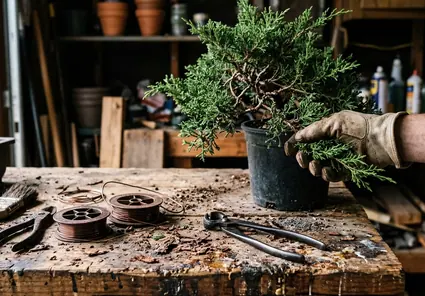
Remove only branches that clearly obstruct wiring or conflict with the chosen structure. Reserve detailed styling & pruning for later. Major bending already places substantial demands on the tree, and extensive foliage removal adds another recovery burden.
Protect and Wire the Trunk
Prepare the supports before beginning the wrap. An elevated, level stand must leave clearance beneath the intended descending tip.
Equipment for the Bending Zone
- Soaked, pliable raffia
- Bonsai wire selected for the trunk’s resistance
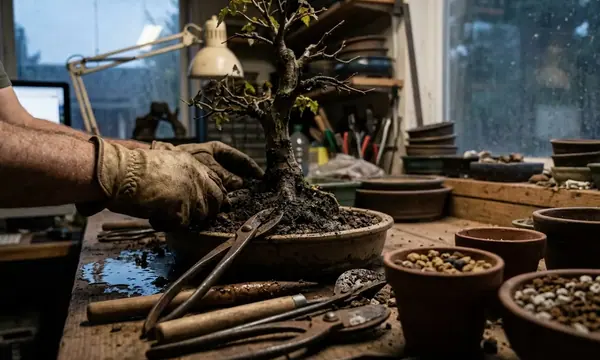
- Wire cutters and branch cutters
- Padded guy-wire material, if needed
- A stable elevated stand and secure container tie-downs
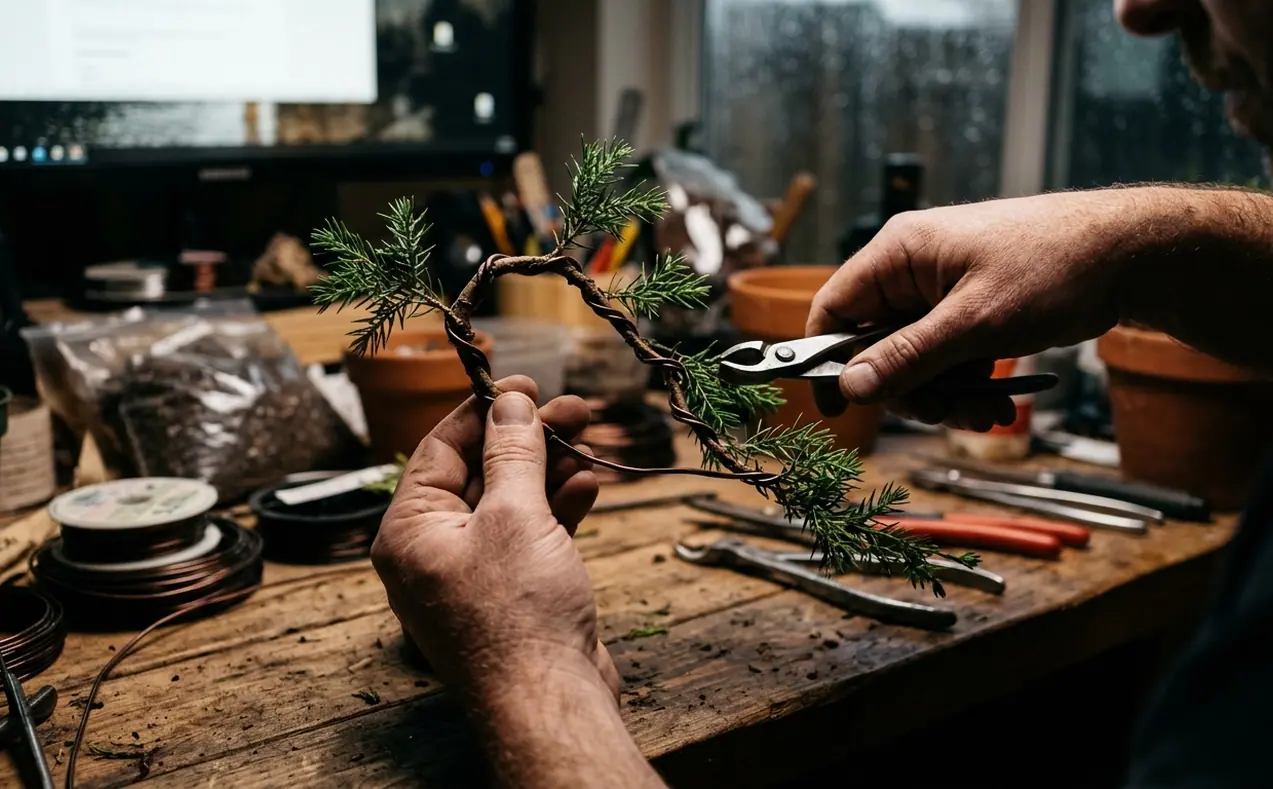
Wrap raffia snugly from below the bending zone upward, overlapping successive turns and extending beyond both ends of the intended curve. The wrapping supports bark and distributes pressure, but fractures remain possible beneath it.
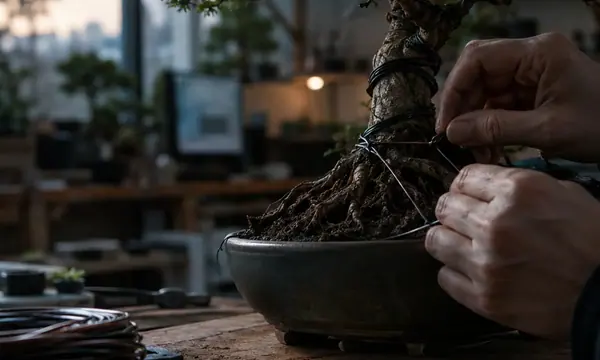
Aluminum wire is more manageable for beginners than copper, which work-hardens during handling. Select wire according to both its material and the trunk’s resistance. Lay an even helix against the raffia without crossed turns or loose gaps. Anchor it securely near the base without driving the end through substantial roots.
Secure the Container
Fix the pot to the stand before applying downward force. Pad every guy-wire contact with rubber tubing, and provide an anchor that allows controlled release of tension.
Lower the Trunk in Small Stages
Picture a trunk whose natural curve already turns sideways above the rim. Extending that movement across the wrapped length spreads strain more effectively than forcing a sharp corner at its base.
- Stabilize the container. Confirm that the pot stays fixed and the root ball remains still.
- Support the bending zone. Keep both hands close to the curve, supporting the outside while applying controlled pressure from the inside.
- Make a small movement. Lower the trunk only a short distance without unnecessary twisting or levering against the roots.
- Pause. Hold the position and listen before applying more pressure.
- Inspect. Check the raffia edges, bark, and substrate around the base. Repeat only while resistance remains steady and the structure stays intact.
Stop at a Creak
Cracking, bark lifting, soil heaving, or sudden softening under the thumbs ends the attempt. Tightening a guy wire after a split can hold the damaged wood open.
Use a guy wire to retain a position already reached under controlled hand pressure. Raffia and structural wire distribute and hold forces; neither makes an unsuitable trunk safe. Leave fine branch placement for another session.
Support Recovery and Watch the Wire
Keep the juniper outdoors, with temporary protection from drying wind and harsh afternoon exposure. Avoid indoor recovery and prolonged deep shade. Restore normal outdoor light as healthy growth resumes.
Check substrate moisture before watering, using a finger or chopstick alongside observations of drainage. Reduced foliage and changed weather can alter water use, so a fixed watering calendar provides a poor guide.
Inspect wire contact points frequently during active growth, especially around the curves. Bark bulging beside a coil signals constriction. Cut each turn and lift the pieces away rather than unwinding wire across the bark. If support remains necessary, rewire along a different path.
Green foliage alone does not establish recovery: junipers can retain their color after serious injury. Watch for progressive yellowing, bronzing, tip dieback, or bark separation. Keep the pot and trunk stable, and defer root work and further major pruning until sustained healthy extension demonstrates recovery.
Leave the First Bend Supported
The first session ends at the angle the trunk accepts without disturbing its root ball. That position may remain above the rim. Preserve the foliage, confirm the tip clears the bench, and check each support before stepping away.
At the bench, a grower checks the raffia-wrapped juniper on its raised outdoor stand. The root ball remains still. The trunk rests at its first supported angle, and the grower leaves the guy-wire tension unchanged.