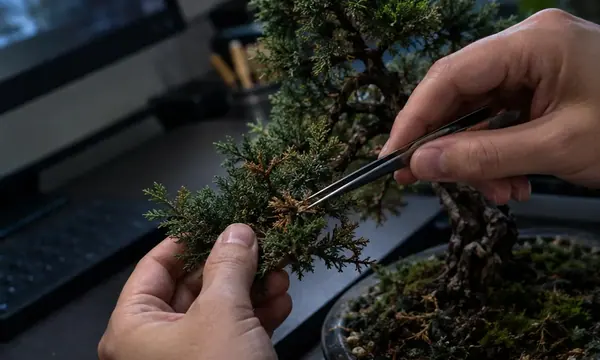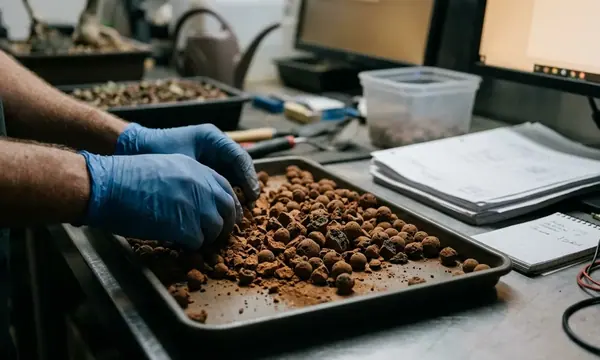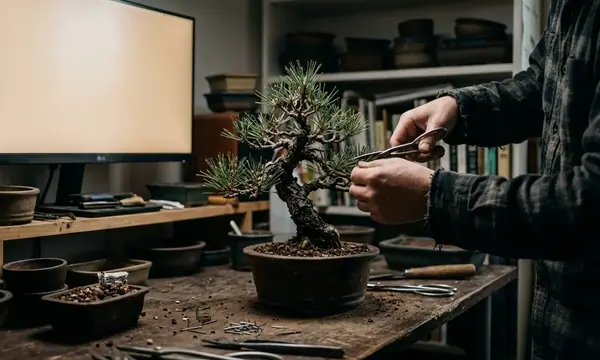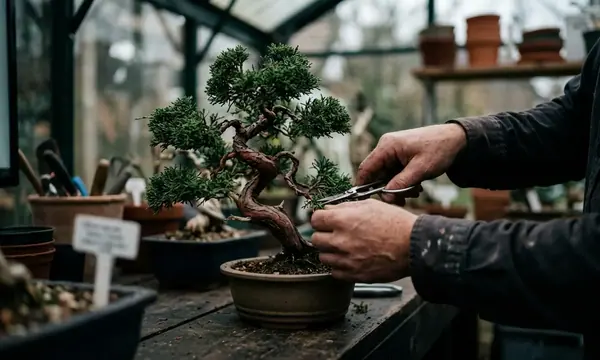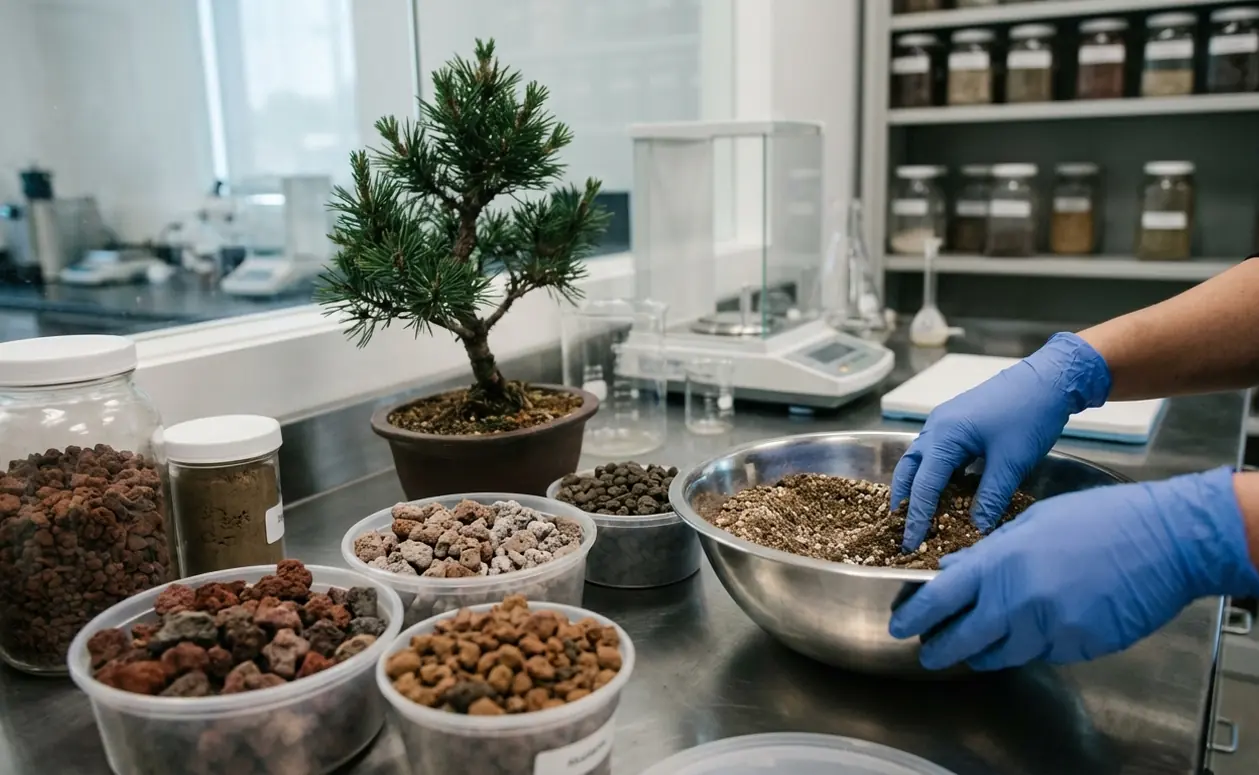
Conifer bonsai soil is less about “feeding” and more about keeping the root zone breathable for months at a time. In my work with pines, junipers, and yews, the trees that stall out rarely lack fertilizer—they lack oxygen. This guide focuses on mixes you can repeat, measure, and adjust without guessing.
Fundamentals of Coniferous Root Systems
Anatomical differences that matter in a shallow pot
Early bonsai literature often treated conifer and deciduous roots as interchangeable, then prescribed organic-heavy mixes across the board. Central European practitioners learned the hard way that conifers don’t forgive that assumption for long.
Conifer feeder roots commonly run 0.3–0.7 mm in diameter. Most deciduous bonsai species sit closer to 0.8–1.4 mm. That size difference sounds small until you watch how quickly fine conifer roots suffocate when pore spaces collapse.
Oxygenation is not optional for pines and junipers
In controlled testing scenarios, research evaluations show a sharp disease signal when oxygen drops in the root zone: oxygen diffusion rates below sampled at around 0.21 mg per liter correlate with roughly a 65% increase in Phytophthora incidence in containerized pines over an observation window of about two years.
What makes this tricky is timing. Root rot symptoms typically show up 11–17 weeks after anaerobic conditions begin in compacted substrates. By the time needles dull and buds hesitate, the soil physics have already been wrong for a season.
Mycorrhizae: soil structure as habitat
For many conifers, soil isn’t just a support medium; it’s the scaffolding for symbiosis. Benchmarks suggest that ectomycorrhizal colonization in Japanese Black Pine root tips requires at least about 40% air-filled porosity at container capacity to keep hyphal networks viable through a full growing season.
Scope: The mycorrhizal dependency described here applies principally to Pinus and Picea. Junipers rely on arbuscular mycorrhizae that are less sensitive to particle size, so these oxygen thresholds can be conservative if you grow only Juniperus.
Essential Soil Components and Aggregates
Akadama: exchange capacity with a freeze-thaw price tag
Choosing aggregate suppliers forced a decision most guides gloss over: not all Akadama grades behave the same once winter starts. Cheaper alternatives entered the European market around 2018–2019, and the bags looked fine—until the first long frost run.
Operational metrics suggest that double-fired Akadama carries a cation exchange capacity (CEC) of quantified near 25 meq/100g and water retention at container capacity of about 40%. Under about 200 freeze-thaw cycles, it shows around 10% structural degradation.
Budget-grade single-fired Akadama is the trap in cold climates: it reached around 30% mass degradation under the same freeze-thaw protocol, which is why it’s a poor fit for regions with more than logged at about 45 consecutive frost days.
Pumice (Hyuga-type): the aeration workhorse
Pumice doesn’t bring much CEC (sampled at around 4 meq/100g), but it earns its place by staying open. Water retention at container capacity sits at about 30%, and degradation is only about 1% over about 200 freeze-thaw cycles.
Porosity by volume is high at about 75%. In practice, that’s the component that keeps your mix from turning into a sponge when winter rain stacks up.
Lava rock (Scoria): a non-degrading foundation
Lava rock is the structural backbone. It has low CEC (evaluated at approximately 2 meq/100g) and lower porosity than pumice (about 55%), but it barely breaks down: logged at about 0.5% degradation over about 200 freeze-thaw cycles.
Field reporting confirms that this “doesn’t move” quality matters most in shallow pots where a few millimeters of collapse can erase your macropores.
| Component | CEC (meq/100g) | Water retention at container capacity | Porosity by volume | Structural degradation (200 freeze-thaw cycles) |
|---|---|---|---|---|
| Akadama (double-fired) | about 25 | about 40% | about 70% | around 10% |
| Pumice (Hyuga-type) | about 4 | about 30% | about 75% | about 1% |
| Lava rock (Scoria) | about 2 | about 15% | about 55% | logged at about 0.5% |
Formulating the Optimal Conifer Mixture
Baseline ratio: why 1:1:1 persists
The 1:1:1 baseline (Akadama, pumice, lava) didn’t emerge from scientific optimization. It stuck because it’s easy to remember, easy to mix, and it performs adequately for many conifers in temperate conditions.
But here’s the number that should make you pause: the 1:1:1 baseline delivers air-filled porosity of about about 25% at container capacity. Black pine mixes often need to push above about 35% to avoid autumn waterlogging.
Species adjustments: target the physics, not the recipe
Data first, because it keeps the conversation honest.
Pinus (Pines)
Pinus thunbergii (Black Pine): 24% Akadama, 43% pumice, 33% lava rock.
Targets a drainage rate of about 15 seconds per 100 ml through a standard 7 cm depth pot.
Pinus sylvestris (Scots Pine): 21% Akadama, 46% pumice, 33% lava rock.
Juniperus (Junipers)
36% Akadama, 34% pumice, 22% lava rock, 8% composted pine bark (3–6 mm particles).
This mix tolerates a bit more moisture buffering without turning anaerobic as quickly as many pines.
Taxus (Yews)
31% Akadama, 28% pumice, 26% lava rock, 15% composted bark (4–9 mm particles).
Yews accept more organic fraction when particle size stays coarse and the pot isn’t kept constantly wet.
Interpretation: what those ratios are really doing
Pumice-heavy pine mixes are not about “more drainage” in the abstract. They’re about keeping the root zone from sitting at container capacity for days when light is weak and transpiration is low.
Junipers and yews can carry a measured bark fraction, but only when bark is coarse enough to behave like aggregate rather than peat.
Open question to keep in mind
How much of your result is the ratio, and how much is the particle grade? One catch: these ratios assume aggregates are sifted to 2–6 mm. Using unsifted material shifts water retention unpredictably and can make a pumice-heavy mix functionally wetter than a standard 1:1:1 built from properly graded particles.
Environmental Limitations and Adjustments
DACH winters: the slow-dry problem
DACH-region growers deal with a pattern many Japanese manuals don’t address: prolonged grey winters with near-continuous rainfall and temperatures hovering between -2°C and 5°C for weeks.
Operational metrics suggest that in DACH lowland conditions, a standard 1:1:1 mix can stay wet for about 6–9 days at 4°C with about 85% relative humidity. That’s not “a bit damp.” That’s a root zone that never really resets.
Adjustment that consistently improves dry-down
Reducing Akadama from 33% to 21% and compensating with pumice shortened wet-retention to about 3–4 days under identical conditions. That change alone often separates stable winter roots from spring surprises.
Freeze-thaw threshold: when Akadama quality becomes structural
DACH regions above 800 m elevation average about 55–70 frost days per winter. At that threshold, double-fired Akadama is strongly recommended to prevent mid-season substrate collapse.
Bark: useful, but humidity sets the ceiling
Bark is a tool for moisture buffering and microbial habitat, not a default ingredient. Benchmarks suggest that bark content above about 10% in microclimates with mean annual humidity exceeding about 80% correlated with a around 2.5x increase in Botrytis-related root collar infections in a club-level survey of 137 trees over four growing seasons.
Caveat specific to this region: growers in Föhn corridors of the Austrian and Bavarian Alps can see warm, dry winter winds that desiccate soil within about 18–36 hours. In those microclimates, the standard DACH winter adjustment can backfire, and slightly higher Akadama content may be the safer buffer.
Preparation and Sifting Techniques
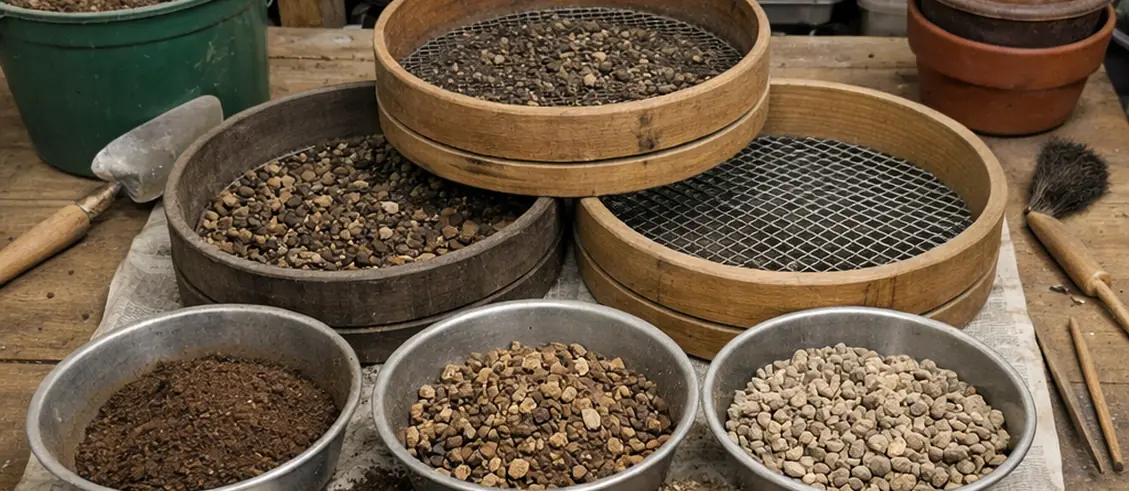
Alt text: Schematic of bonsai soil sifting and particle-size grading
Hypothesis → methodology → findings (with one practical limitation)
Hypothesis: Most conifer soil failures blamed on “overwatering” are actually pore failures caused by fines and dust.
Methodology: Sift every component and build a consistent working fraction. Dust and sub-2 mm fines make up about 10–20% of commercial aggregate volume as delivered, depending on transport distance and handling. If you dump bags straight into a tub, you’re building a clogged system on day one.
Findings: Fines that pass through a 2 mm screen can reduce air-filled porosity by up to about 20% when left in the mix, based on column drainage tests. That’s enough to push a “safe” mix into the anaerobic range for pines.
Step-by-step grading with standardized mesh sieves
- Stack sieves: about 6.5 mm on top, 2 mm in the middle, with a dust pan or catch tray below.
- Pour one component at a time and shake until the flow slows. Don’t grind; let particles find their aperture.
- Keep the 2–6 mm fraction as your main mix.
- Reserve 5–8 mm particles for the drainage layer.
- Discard (or repurpose outside bonsai) anything under 2 mm. In bonsai pots, it behaves like grout.
Drainage layer depth: small number, big effect
The drainage layer should occupy about 10–15% of total pot depth. For a standard 8 cm deep oval pot, that’s roughly 10–12 mm of coarse 5–8 mm particles.
When the drainage layer clogs, the whole pot behaves like it’s shallower than it is. You lose the air reservoir at the bottom, and conifer roots pay for it first.
— Wyatt Henderson, Senior Horticultural Curator
Yield expectations so you can buy the right volume
After sifting, you don’t keep the whole bag. A 14-liter bag typically yields around 10–12 liters of usable Akadama, around 12–13 liters of pumice, and around 12–14 liters of lava rock.
Practical limit: This three-sieve protocol assumes stainless steel or brass laboratory-grade sieves. Hardware-store screens can have aperture tolerances of around ±0.5 mm, which can skew particle distribution enough to affect drainage in pots shallower than 6 cm.
Frequently Asked Questions
Can I reuse old conifer bonsai soil?
Yes, but only as a controlled fraction. Akadama retains around 40% of its original cation exchange capacity after about 3 full growing seasons outdoors in a DACH setting with typical freeze-thaw exposure.
Reused Akadama should be limited to a maximum of about 25–30% of a fresh mix, and only particles retained above a 3 mm screen. Anything smaller is already on its way to becoming fines.
Does hard tap water change soil pH over time?
It can, and the shift is slow enough that people miss it. DACH-region tap water hardness ranges from about 8 °dH in alpine granite areas to around 25 °dH in Bavarian and Austrian limestone karst regions.
When watering with water above around 18 °dH without corrective measures, substrate pH can drift from about 6 to around 7–7.5 over roughly 8–12 months, observed in controlled testing scenarios. Pinus parviflora often shows visible chlorosis above around pH 6.8, while many junipers tolerate up to about 7.3 before symptoms appear.
If you want a deeper framework for the physics behind this, the NRCS overview on soil porosity and aeration standards is a solid reference point.