What's Inside
- Developing Fine Branching
- Read the Tree Before You Cut
- Run the Clip-and-Grow Season
- Check the Empty Space
- The Refinement Sequence
Developing Fine Branching
At the spring workbench, turn a vigorous Chinese elm shoot slowly between your fingers. The leaves alternate along the stem. Each leaf carries a bud at its base, and that bud can determine where the next segment travels after pruning. The useful cut becomes apparent only after you inspect the shoot as a three-dimensional structure.
The practical goal of clip-and-grow is to replace long, coarse extensions with progressively shorter secondary and tertiary branches. Each division should become thinner and shorter as it approaches the canopy edge. Repeated carefully, this sequence produces a believable deciduous crown with visible movement from trunk to twig.
Ulmus parvifolia suits this method because healthy trees extend vigorously, present readable leaf orientation, and bud reliably on established wood. That responsiveness can tempt the grower to chase density too early. A crowded silhouette may contain poor branch hierarchy, straight sections, crossing twigs, or several shoots emerging from one swollen junction.
This manual addresses one active growing season of refinement. Trunk thickening and recovery work require different priorities. Combining those stages with fine ramification often leaves the grower cutting branches that should still be extending or demanding new growth from a tree that needs foliage.
Refinement Scope
Apply this method to a healthy, established Chinese elm. Allow a weak or recently repotted tree to rebuild vigor before beginning repeated cutback cycles.
Read the Tree Before You Cut
Fine branching begins with hierarchy. Primary branches emerge from the trunk and support secondary branches. Those divide into tertiary twigs, with thickness and length diminishing toward the outer canopy. A branch that lacks this progression will still look coarse after it fills with leaves.
Read each branch from its base outward. The first junctions reveal structural faults that tip-focused pruning can conceal: swelling, crossing branches, duplicated shoots, abrupt changes in thickness, and several stems competing at one point. Pruning several shoots at a junction merely to force density encourages knuckles and inverse taper. Retain the shoots that serve the intended structure and remove competing growth while it remains easy to correct.
Confirm Active Health
Before refinement, check for active growth, normal leaf color, firm shoots, adequate root function, and a stable response to watering. Severe heat, drought stress, pest pressure, or recent repotting should stop the session. Repeated pruning consumes foliage and asks the tree to replace it; a depleted Chinese elm cannot manufacture useful density on demand.
Branch strength also matters within an otherwise vigorous tree. Strong outer tips often receive more resources than shaded interior shoots. Giving both areas the same cut can deepen that imbalance: the outer tip resumes extension quickly while the interior shoot stalls.
Protect Interior Vigor
Reduce strong exterior growth more firmly and leave extra foliage on weak interior shoots. Equal treatment across an unequal canopy preserves apical dominance rather than correcting it.
Set the Structural Intention
Identify the function of each shoot before reaching for scissors. It may need to extend and thicken, divide an established branch, fill a deliberate opening, or be removed because it duplicates existing structure. This decision sets the appropriate extension period and cutback point.
A single extension length does not suit every branch. Vigor, internode length, position, and developmental stage should control the choice. Strong tips can tolerate earlier restraint, while a weak interior branch may need an uninterrupted period of growth.
Run the Clip-and-Grow Season
How should one season progress without reducing every shoot into a uniform hedge? Use alternating periods of extension and reduction. Continuous pinching preserves the outline, yet it gives new branch segments little opportunity to gain strength or establish useful direction.
-
Establish the Early-Season Roles
At the first active flush, separate development shoots from refinement shoots. Let branches that still need thickness extend freely. Watch refined areas closely as their internodes become visible, especially near strong upper and outer portions of the canopy.
Avoid cutting solely because a shoot has crossed the silhouette. The outline offers little information about the branch's internal structure. Inspect the leaf arrangement, the spacing between nodes, and the direction required for the next segment.
-
Alternate Extension and Reduction
Allow an established shoot to extend until it demonstrates clear vigor and readable leaf orientation. Then trace it back to a small group of useful leaves, often a pair, when those leaves offer the required next direction. Place the cut just beyond the selected bud and leave enough stem to avoid damaging the retained node.
After the cut, let the retained bud extend before judging the result. The new segment should continue the branch with a change in direction and a reduction in thickness. If several new shoots emerge near the same point, select for structure rather than keeping all of them for immediate fullness.
Repeat the cycle only after the branch has regained active, stable growth. Some areas may complete several useful extensions while weaker zones complete fewer. The tree should finish the season more balanced, not uniformly processed.
-
Pause During Growth Slowdowns
Intense summer heat can shorten active growth or leave foliage working mainly to support the tree. Preserve leaves during that slowdown. Resume demanding refinement when shoots again extend firmly and watering produces a stable response.
Wiring requires similar restraint. Young elm shoots can thicken rapidly, so inspect wire frequently and remove it before it bites into the bark. Clip-and-grow can establish much of the movement, leaving wire for corrections that pruning alone cannot place accurately.
-
Review the Bare Structure
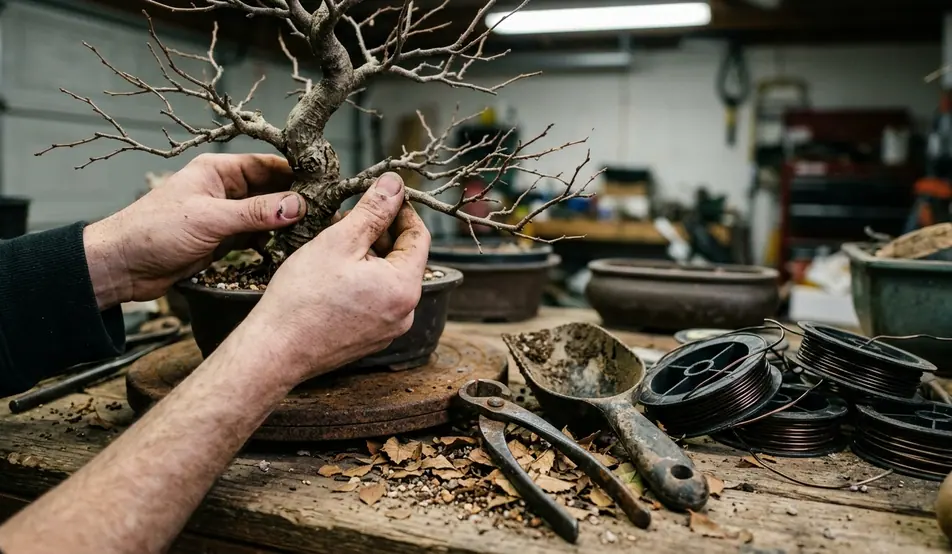
Late in the season, reduce the frequency of pruning and allow useful growth to mature. Once the canopy becomes leafless or carries reduced foliage, inspect every branch from several angles. This is the clearest time to find parallel twigs, inward growth, repeated forks, abrupt taper, and shoots hidden inside dense foliage.
Follow the route from trunk to primary branch, then through the secondary division and into the tertiary twigs. Each transition should remain readable. Mark questionable areas mentally and avoid making a large collection of corrections merely because the structure has become visible.
Check the Empty Space
Before every directional cut, look beyond the current shoot and identify the empty space that the next segment should occupy. This small pause changes the question from “Where can I shorten this?” to “Where should this branch travel next?”
Consider a retained leaf that appears to point outward when viewed from the front. From above, its bud may aim directly across an adjacent branch. If allowed to extend, the new shoot creates a crossing twig and forces another correction. The original cut shortened the branch without advancing its structure.
Use a Three-Angle Check
- View the selected leaf from the intended front.
- Rotate the tree and inspect the bud from the side.
- Look from above to check for crossings, parallel growth, and movement into another branch's space.
- Confirm that the new direction preserves separation from neighboring twigs.
The final retained leaf acts as a directional instruction. Its bud should send the next segment into available space while maintaining the branch's overall line. Leaf orientation remains only one part of the decision; internode length, taper, branch strength, and junction quality still govern whether that node deserves to remain.
Cut Into Space
Choose the retained bud by the space its future shoot will occupy. Rotate the tree before cutting, even when the direction appears obvious from the front.
The Refinement Sequence
A controlled clip-and-grow cycle follows a clear order: establish health, identify the branch hierarchy, allow useful extension, cut to a directional leaf, protect weaker areas, and reassess after regrowth. Skipping the health or structural checks turns pruning into silhouette maintenance.
Density should emerge from sound divisions. Preserve taper, separation, believable movement, and a readable route from trunk to twig. A sparse branch with useful structure can continue developing; a dense branch built from swollen junctions and crossing shoots carries faults that become harder to remove each season.
Seasonal timing shifts with climate, growing conditions, and tree vigor, so visible growth provides a better working signal than a fixed calendar. Start only when the tree extends actively, pause when growth loses stability, and give weak areas enough foliage to recover.
Build Direction First
Use repeated directional extension-and-cutback cycles as the primary refinement method for Chinese elm, and leave constant pinching and wholesale defoliation out of the plan.