The Trident Maple Recovery Log
What's Inside
- Diagnosis: why the root zone could not wait
- Failed responses: four dry days without change
- Emergency repotting on Day 2
- Protected aftercare through Day 14
- Recovery evidence from Week 2 onward
- Practical root-inspection gate
- What this case record can support
- The decision order carried forward
The anchor names follow the completed journal rather than the intended treatment plan. The entry first drafted as treatment became “The First Course Fails” after four days without watering produced no change in pot weight. That distinction matters because the chronology records decisions as evidence accumulated, including the measures that did not alter the root environment.
The dated record runs from Day 1 to Day 41. Interpretive entries sit between those dates to explain why a specific observation changed the course of treatment.
A Waterlogged Maple Cannot Wait
Severe compaction combined with persistent saturation calls for prompt correction once the evidence is clear. In that situation, delaying intervention can threaten more roots than a carefully controlled emergency repotting.
This case concerns one mature Acer buergerianum with a trunk base roughly 9 cm across. It occupied an unglazed rectangular pot measuring approximately 41 × 30 × 9 cm and had gone four growing seasons without repotting. The problem developed in late May, outside the usual Trident Maple repotting window from late winter to bud swell.
Those details set the limits of the record. This is a chronological account of one tree, one root mass and one mid-season recovery course. The decision to repot depended on pot weight, drainage time, the sealed surface and the roots found after removal from the pot.
Case Boundary
Use the observations to sharpen diagnosis, rather than treating the dates as a universal cultivation and care schedule.
Day 1: The Maple Signals Trouble
What justified disturbing a stressed maple outside its normal repotting season? Three observations formed the threshold.
Shoot extension had stopped while sibling trees on the same east-facing bench continued to push. The pot also felt heavy at a time of day when it should have become lighter. Finally, irrigation water pooled on the surface for roughly 90 seconds while the drainage holes remained dry.
That stationary water supplied the decisive physical clue. The surface remained dark and cool more than 48 hours after the previous watering, and a dense moss mat sealed the top of the soil. Restricted pore space within the old substrate left little route for water to drain or air to return around the fine roots.
The weather and watering record reinforced the concern. Rain had fallen on nine of the preceding fourteen days, yet the tree had also received water according to the same daily hand-watering habit. Its bench received direct sun until approximately 11:30, followed by fence shade. No coordinates were recorded for the tree.
Leaf appearance alone did not trigger treatment. The combination of arrested extension, retained pot weight and failed drainage moved the case from observation to investigation.
On this tree, the minute-and-a-half surface pool carried more diagnostic weight than any isolated change in a leaf.
Day 1: The First Course Fails
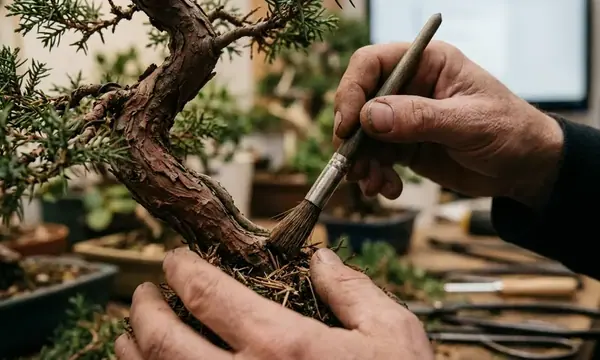
The initial response followed the least disruptive path. Water was withheld, the maple was moved under cover to exclude further rain, and the moss mat was removed. The uppermost soil was then picked open to a depth of approximately 1 cm.
Each action tested the same working explanation: excessive incoming water might be keeping an otherwise functional soil body wet. Lifting the moss could improve evaporation and admit some air at the surface. Shelter would also prevent rain from obscuring the result.
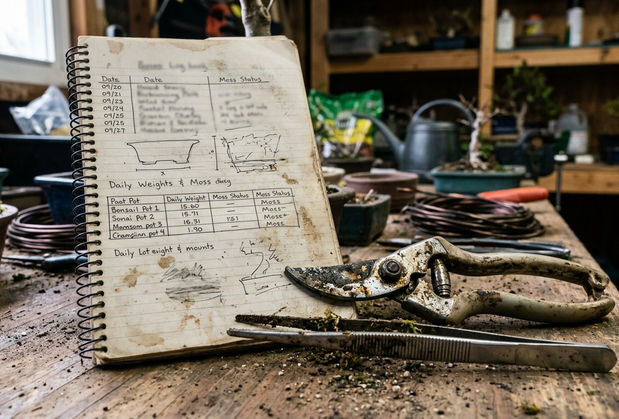
Pot weight was assessed by hand at the same time each morning. After four consecutive days without water, there was no measurable lift in weight and no change in shoot posture.
The outcome shifted attention below the loosened surface. Opening the top centimetre could not restore connected air spaces through a compacted root mass. Water remained trapped within the intact core, beyond the reach of a surface adjustment.
Surface Limit
Moss removal may improve the top boundary of a pot. It cannot repair collapsed pore structure deeper around the roots.
Day 2: Opening the Root Ball
Work began at 08:00 on an overcast morning at 17 °C. The bench stood in shade, and a wet towel was ready before the tree left its pot. The root ball returned to fresh substrate within about 35 minutes.
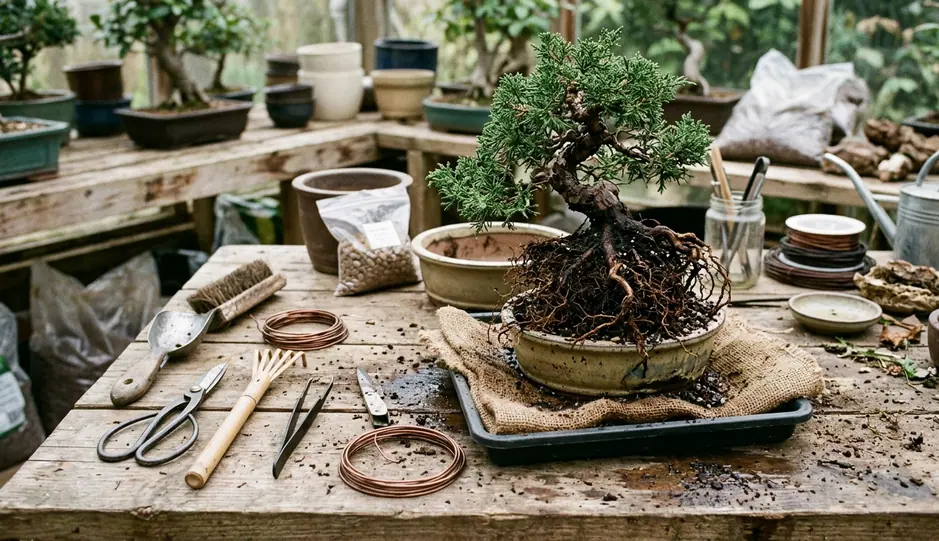
The Emergency Repotting Sequence
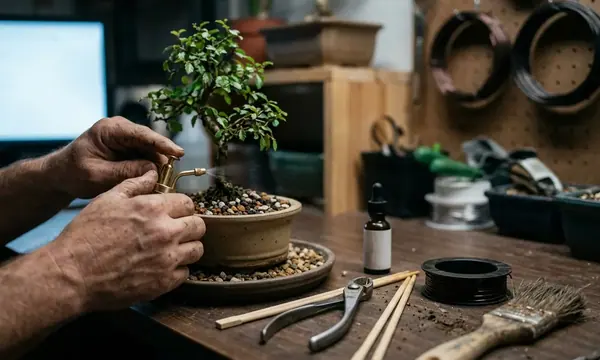
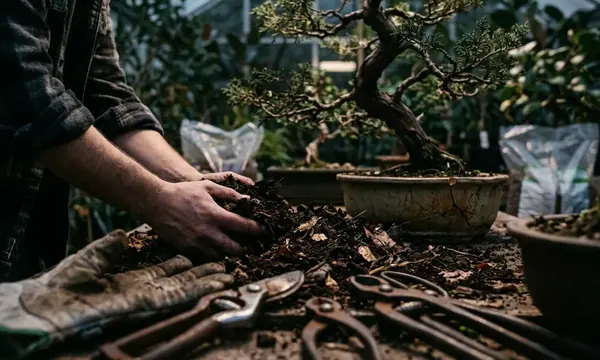
- Prepare the workspace. Lay out rounded bamboo chopsticks, root shears, wire cutters, drainage mesh, tie-down wire and the wet towel. Wipe cutting blades with alcohol before starting.
- Remove the tree. Lift the root ball only after the receiving container, substrate and anchoring materials are ready.
- Examine the root mass. Check texture and structural continuity before deciding where to cut.
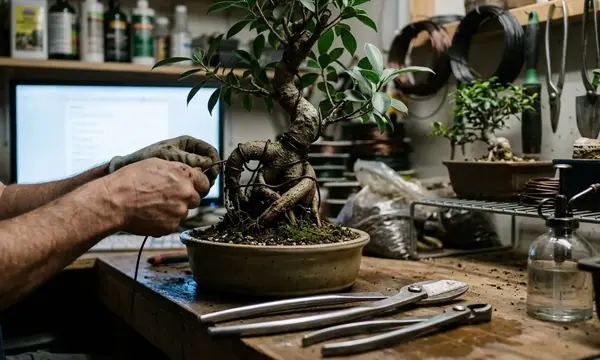
- Release compacted soil. Work inward with chopsticks from the outside. Full bare-rooting under a hose was rejected so the firm core near the trunk could remain intact.
- Identify compromised roots. The outer root shell, about 2–3 cm thick, was dark and soft. Its cortex sloughed away when pinched. The three main radial roots and the mass immediately beneath the nebari remained firm and pale.
- Prune selectively. Remove tissue that collapses or loses its outer sheath while preserving roots that resist pressure and remain intact. Wipe the blades with alcohol again after each pass through compromised tissue.
- Prepare the container. Fit plastic mesh and place a bottom course of 6–8 mm coarse pumice approximately 1 cm deep.
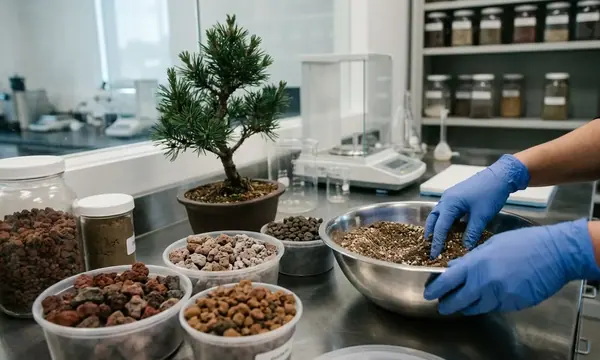
- Add free-draining substrate. Use roughly equal parts pumice, akadama and lava, sifted to 2–5 mm. Wash out the dust before use.
- Secure the maple. Run 2.5 mm aluminium wire through two tie points in the box floor. Tighten until the trunk cannot rock by hand.
- Water it in. Apply water through a fine rose in three passes over roughly 6–8 minutes, continuing until runoff becomes clear rather than turbid.
No percentage target governed root removal. The viable radial roots and firm tissue under the nebari represented the tree’s remaining physiological reserve, so cutting stopped once the compromised outer shell had been addressed and the retained structure could support recovery.
The spent soil plate and removed roots were bagged and taken away from the growing area instead of being composted beside the benches.
Preserve Firm Roots
Root pruning should follow tissue condition. Arbitrary reduction targets can sacrifice viable roots precisely when a stressed maple has little reserve to spare.
Days 3–14: Holding a Steady Course
The aftercare rules were written on the evening of Day 2 and then held steady. Repeated changes in position or watering would have made both recovery and interpretation harder.
The tree stayed on the ground beneath a bench in bright shade. Shade cloth pinned along the windward side reduced moving air across the recently worked roots. It received no direct sun during the first nine days and remained in that position until Day 15, when morning sun resumed.
Observation occurred at roughly 07:00 and 18:00 from Days 3–9, then once daily through Day 21. Each card recorded the date, weather and high temperature, chopstick reading, time for water to clear the drainage holes, leaf condition, shoot posture and any change from the previous entry.
Watering Followed the Substrate
A bamboo chopstick inserted into the root zone supplied one reading; pot weight supplied the other. Water was applied when both checks showed that the substrate had moved toward dryness. This extended the former daily habit to approximately every 2–3 days during the first fortnight.
The aim was controlled moisture. Constant saturation would recreate the failed root environment, while uncontrolled drying could damage roots already reduced by selective pruning.
No fertiliser, pruning, wiring or foliar treatment appears in the Days 3–14 notes. The first weak liquid feed occurred on Day 34.
Intervals Stay Local
This regimen occurred in a temperate maritime spring with daytime highs between 16 and 22 °C. In afternoon temperatures above 30 °C, a shallow mesh-bottomed box in bright shade can dry faster than this interval suggests. The chopstick-and-weight method transfers; the recorded interval does not.
Week 2 Onward: Reading the Return
The first useful recovery sign arrived through water use rather than top growth. From Day 13, the box began drying in about two days instead of about four. An unplanted control box containing the same substrate stood beside it, helping separate root uptake from evaporation.
Earlier signs remained ambiguous. On Day 6, the leaves became limp at midday and firmed again by evening. Eleven leaves fell between Days 3 and 9, after which the loss stopped. The journal recorded cessation of decline without declaring the root system recovered.
- Day 13: the drying interval shortened from about four days to about two.
- Day 17: buds moved at two interior nodes.
- Day 24: the first new leaf pairs opened.
- Day 31: three shoots on the weakest branch dried after two consecutive days at 29 °C with wind.
- Day 41: the maple returned to the morning-sun bench and resumed ordinary watering while observation continued.
The Day 31 setback led to four days back in full shade. It did not erase the earlier evidence, though it showed that new extension and improving water use had not restored full resilience.
No styling, wiring or structural pruning was planned for the remainder of that season. By Day 41, the rebuilt root plate had yet to pass through dormancy, so the record makes no claim about the following winter.
Field Note: Check the Cause Before Cutting
A temporary wilt, one wet day or leaf discoloration alone does not establish root rot. Use a three-step gate before opening the pot.
- Verify the drainage failure. Time how long water stands on the surface and how long it takes to clear the drainage holes. Compare the result with a healthy tree in comparable substrate on the same bench.
- Verify retained water. Lift the pot at the same hour on two or three mornings without adding water. Failure to become lighter supports the case for persistent saturation.
- Verify compromised tissue. Inspect the root zone only when the first two checks justify it. Firm roots that resist pressure and stay intact remain; roots whose outer sheath slides from the core are removed.
Beginners should seek experienced local help when a valuable tree is involved or when living and dead roots cannot be distinguished confidently. Once cut, a viable root cannot be restored.
What This 41-Day Record Can Support
The evidence consists of dated field notes from a single Trident Maple, combined with general cultivation practice. There was no controlled trial, comparison group or replication. The unplanted substrate box helped interpret drying speed, but it did not turn the case into an experiment.
That scope still supports several practical judgements. Persistent pot weight and delayed drainage can reveal a root-zone problem before leaf symptoms become specific. Root texture can guide conservative removal. Stable positioning and repeatable moisture checks make subtle changes easier to interpret.
The record cannot establish a guaranteed schedule for another maple. Container depth, root loss, substrate, heat and wind all alter the pace of drying and recovery.
The Order That Protected the Maple
Six actions carry forward from the journal: diagnose, expose, preserve, secure, monitor, wait. The emergency work occupied about 35 minutes; deliberate restraint continued for roughly six weeks.
The central lesson lies in that imbalance. Precise root work corrected the immediate physical problem, while stable aftercare gave the retained roots time to function without competition from fertilising, styling or structural pruning.
When your own Trident Maple stays heavy and surface water stalls above dry drainage holes, will you keep treating the foliage or verify what is happening inside the root plate?