What's Inside
- The Illusion of the Saw
- Visual Disconnects and Callus Realities
- Sequencing the Reduction
- Bench-Side Verification
- Earning the Reduction
- Irreversible Decisions in Cultivation
The Illusion of the Saw
Growers commonly leave development stock to run two to five growing seasons with its apex and sacrifice growth untouched before attempting any major reduction. The thickening happens entirely during those seasons while the foliage mass remains attached and actively photosynthesizing. Trunk caliper is measured just above the soil line. The saw alters only the height and the position of the apex. Cutting before the tree has a viable replacement leader and sufficient vigor trades apparent speed for an awkward transition and a difficult wound.
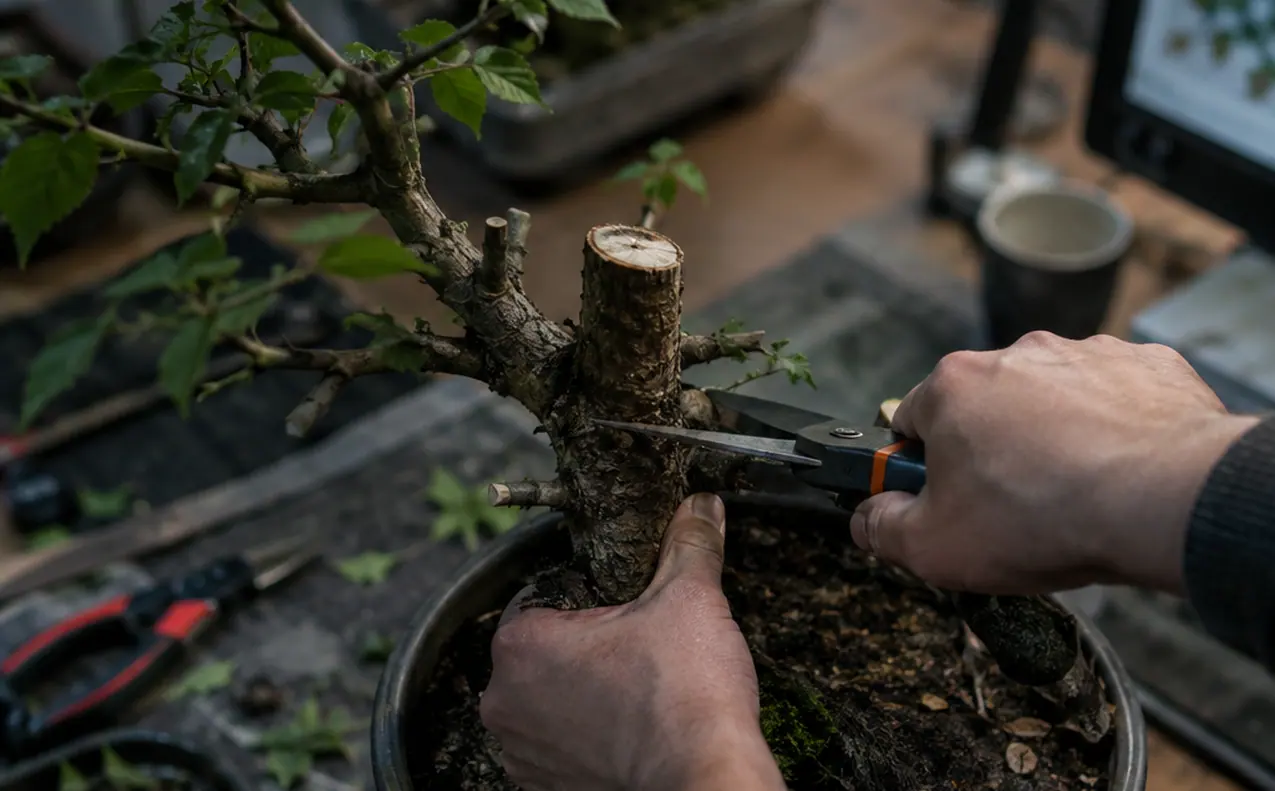
A chop placed near one-third of the intended finished height leaves the remaining two-thirds of the silhouette to be rebuilt from a successor leader over subsequent seasons. The kerf acts as a strict boundary. Everything below the cut line remains developable material. Everything above it represents a decision already spent and unrecoverable by any later technique. The urge to see a smaller bonsai silhouette often drives premature cuts. Patience during the initial development phase yields a stronger foundation. A trunk chop changes none of the basal thickness; it merely reveals what the growing seasons have already built.
Visual Disconnects and Callus Realities
The eye registers the diameter change at a junction before it reads branch placement. A thick base ending abruptly at a thin shoot reads as a stump regardless of how the branches are later styled. Callus advances inward from living cambium at the rim of the wound. A cut face left on a tree whose foliage mass was simultaneously reduced has less energy to push that rim. An exposed rim in hot, dry, full-sun placement retreats further before it ever rolls.
Closure behavior differs sharply by species and vigor. Fast-callusing broadleaf stock in active growth behaves differently than a conifer with resinous, slow-rolling wounds. No single healing timeline covers both scenarios. A decisive chop can efficiently create a low bonsai from vigorous, well-developed stock, provided the tree already has an appropriate branch or bud for a new leader and the capacity to recover. Repeated topping removes the foliage that was thickening the trunk. Each reduction restarts the leader at a smaller diameter. The trunk gains less per season than if one leader had been left to run. The visual flow of the tree depends on maintaining proportional transitions from the base to the apex.
Sequencing the Reduction
How do we determine the right moment to cut? The decision sequence begins with identifying the intended finished height and trunk line. Every later judgment relies on that baseline. Inspect where a new leader could emerge, comparing its diameter and direction with the lower trunk, and assess tree vigor before cutting. A successor measuring roughly one-third to one-half the trunk diameter at the cut gives a readable transition. Equal diameters read as a fork. A tenth of the base reads as a graft.
Retain growth where it is needed to strengthen the trunk or successor leader, then shorten in stages as transitions develop. Low sacrifice branches kept running for two to four seasons thicken the trunk section below them while the apex is held short. Choose a successor that continues the trunk line naturally rather than accepting the nearest upright shoot. On species prone to dieback at a cut, leaving one to three centimeters of stub above the chosen bud or branch gives the retreat somewhere to go. The stub is removed later once the new leader has hardened and taken over. A sloped cut angled away from and behind the new leader sheds water off the face instead of pooling it against the successor's base.
After a major cut, keep the root run and remaining foliage intact, watch the rim for retreat, and hold off repotting or heavy branch work until the successor has produced a full season of extension. These sequencing principles assume a species that will produce buds on older or bare wood. Most junipers, spruces, firs, and many pines require the replacement leader to already exist as live, foliated growth before the saw is picked up. Without existing foliage, these species will simply abandon the cut section.
Bench-Side Verification
Before sawing, point to the future leader, trace the proposed trunk line, and look at the cut from the intended front. Stepping back to roughly three times the tree's height is enough to judge the silhouette. From arm's length, the diameter step at the junction is nearly impossible to see. A photograph taken at the eye level of the intended viewing height and converted to grayscale drops foliage color and shows the trunk's diameter transitions plainly.
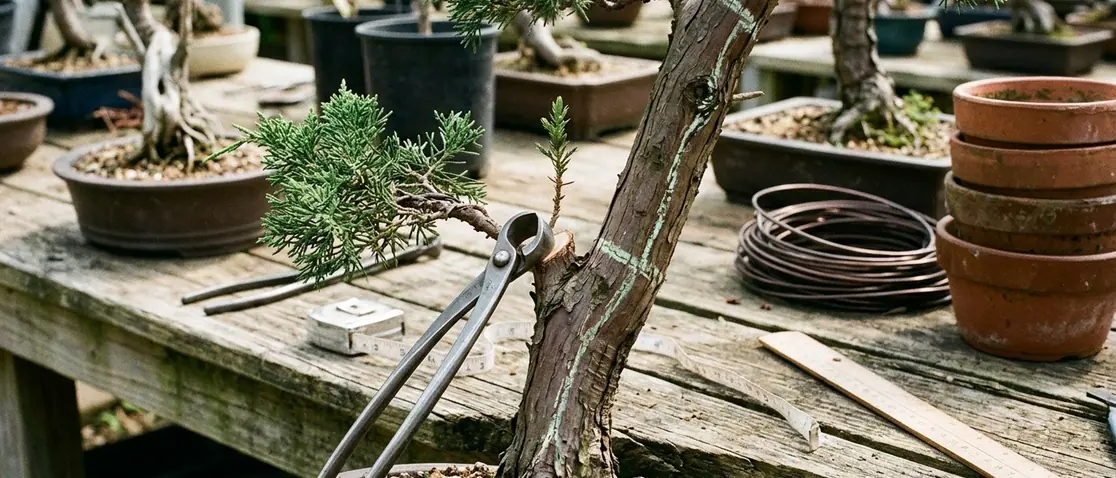
If the candidate leader is thinner than roughly a quarter of the trunk at the chop point, or emerges on the back of the intended front, the case for waiting another season is stronger than the case for cutting. The live tree's vigor and available growth determine whether the plan is feasible. A visual check confirms the alignment of the future apex with the established base.
Earning the Reduction
Three conditions must all hold: a named successor branch or bud, a trunk line that continues naturally through it, and vigor sufficient to push extension growth in the season following the cut. When any one condition is missing, the default verdict is to keep developing. The tree loses nothing by waiting. The removed apex is unrecoverable. A premature cut forces the grower to spend subsequent seasons correcting a flawed transition rather than building upon a solid foundation.
Irreversible Decisions in Cultivation
Species-specific responses—such as budding on old wood, dieback tendency, speed of callus roll, and dormancy timing—govern how these principles apply to an individual tree. The condition of the individual specimen dictates the appropriate timing for any major structural work. A chop taken 10 centimeters lower than intended cannot be reversed. The remedies are rebuilding a leader over additional seasons or redesigning around a shorter trunk, and neither restores the removed section.