What's Inside
- Criteria for Judging Fertilizer in Bonsai
- Organic vs. Synthetic Bonsai Fertilizer
- Seven Reasons I Left Synthetic Fertilizer
- Pros and Cons of the Organic Shift
- My Current Organic Feeding Method
- Where Synthetic Fertilizer Still Belongs
- Key Takeaway
- Bibliography
Synthetic bonsai fertilizer gave me predictable growth when I needed it. Over somewhere around three to four growing seasons of collection observation, though, I began favoring organic bonsai fertilizer for most long-term maintenance, especially in shallow containers where watering, substrate structure, and seasonal timing decide more than the label on the bottle.
What Changed in My Bonsai Feeding
I did not leave synthetic fertilizer because it failed.
In fact, soluble fertilizer still taught me useful lessons about timing, concentration, and deficiency correction. When a tree needed a measured push during active growth, synthetic feeding gave a fast and legible response. That predictability has value, particularly when the grower controls water quality, substrate, and flushing with discipline.
My preference shifted because bonsai containers are not small garden beds. They are shallow, frequently watered systems with limited buffering capacity. A mame pot, a training tray, and a refined conifer pot each handle nutrients differently, even when the same product touches the surface.
I am writing from a container-collection perspective, not a universal condemnation of synthetics. Ground-grown stock, field production, and nursery development material operate under different physical constraints.
Criteria for Judging Fertilizer in Bonsai
What should a bonsai fertilizer do besides contain nitrogen, phosphorus, and potassium?
That question matters because bonsai roots live in a restricted volume of substrate that we disturb on a schedule. Most conifers and deciduous species get root work at intervals of somewhere around one to three years, depending on vigor and pot size. A fertilizer that performs well in a garden border can still create awkward management problems in a bonsai pot.
I judge fertilizer by criteria I can observe without instruments:
- Release speed: Does the product feed gradually, or does it place nutrients into solution immediately?
- Salt accumulation risk: Does repeated use leave visible crusting or require stricter flushing habits?
- Effect on substrate biology: Does the feeding method encourage biological breakdown, or does it bypass that process entirely?
- Seasonal fit: Does the release pattern match the tree’s active growth, hardening, dormancy, or recovery period?
- Ease of correction: Can I stop, remove, dilute, or adjust the feed without disturbing roots?
- Odor and pest management: Can I use it cleanly in a collection where birds, rodents, pets, or fungus gnats may notice it?
- Repotting compatibility: Does it support recovery after root work, or does it tempt me to feed before new roots can use it?
Beginners can use the same list. Advanced growers can apply it more narrowly: internode length on trident maple, needle density on pine, fine ramification on elm, or post-pruning recovery on juniper.
Organic vs. Synthetic Bonsai Fertilizer
A late-autumn organic cake applied as temperatures fall may sit intact until spring, giving no feeding effect when the grower expected it. That single detail explains why I avoid declaring one approach superior in every season.
Organic and synthetic fertilizers behave differently because they enter the root zone differently. Organic cakes and pellets depend on moisture, warmth, and biological activity. Synthetic fertilizers make nutrients available quickly, which helps when correction matters but raises the need for careful dosing and flushing.
Decision-focused comparison of organic and synthetic bonsai fertilizer| Feeding approach | Release behavior | Main benefit | Main risk | Best use case | Watch points |
|---|---|---|---|---|---|
| Organic cakes or pellets | Gradual release as material softens and breaks down under warm, moist conditions | Encourages steady observation of surface moisture, drainage, and cake condition | Odor, pests, crusting, or poor breakdown in cold or biologically quiet media | Long-term maintenance of healthy container-grown bonsai | Remove spent material before it slumps into a drainage-blocking layer |
| Synthetic liquid or granular fertilizer | Immediate nutrient availability when dissolved or watered in | Useful precision for targeted deficiency correction or controlled production | Overdosing and soluble salt accumulation in small containers | Short corrective feeding, inert media, or tightly managed nursery routines | Dose carefully, flush intentionally, and avoid feeding weak roots aggressively |
| Combined seasonal approach | Organic base feeding with occasional soluble correction | Balances gradual maintenance with specific intervention | Confusing results if the grower changes too many variables at once | Mixed collections with both refined trees and developing stock | Keep notes by species, pot size, and season rather than by product alone |
Seven Reasons I Left Synthetic Fertilizer
1. Gradual release suited shallow bonsai pots
In practical scenarios, small soil volumes make sudden nutrient availability harder to manage. Some shallow bonsai trays hold well under a liter of substrate, yet they may need water two to four times on a hot summer day. In that setting, every dissolved input moves fast.
Organic cakes soften over time rather than acting all at once. Under regular watering in warm weather, they typically take one to three weeks to visibly soften and break down. That slower release gave me more room to observe tree response before changing the feed again.
2. Organic cakes kept me attentive to substrate condition
The cake on the surface became a diagnostic marker.
If it stayed dry, I knew water was not passing through that area. If it melted into a sticky mat, I knew I had waited too long to clean the surface. If birds or rodents bothered it, I changed placement or used covered baskets. Feeding became part of the inspection routine rather than a separate chore.
The point is simple: bonsai fertilizing should sharpen observation. A product that hides poor watering, poor drainage, or stale substrate does not help the tree in the long run.
3. I wanted a calmer relationship with salt buildup
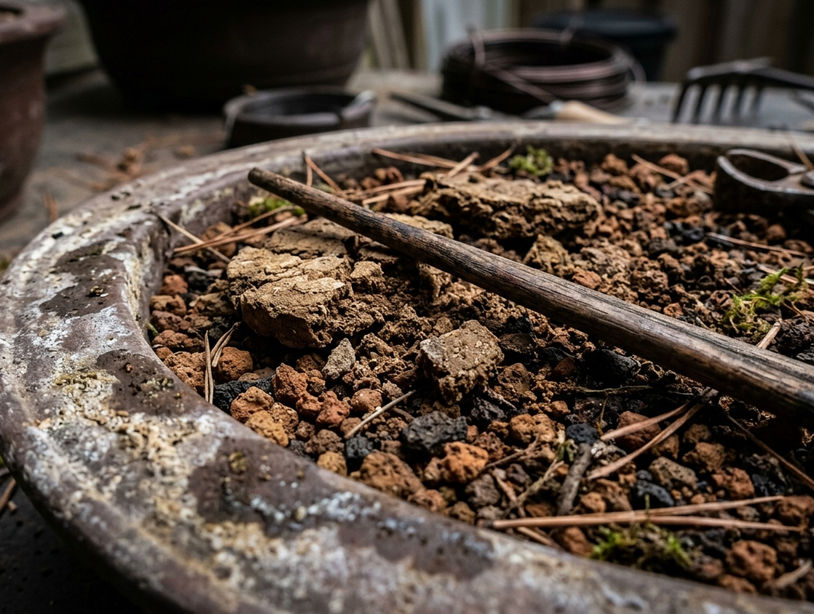
My concern around soluble salts came from visible surface crusting that returned between flushes, not from a controlled side-by-side comparison. That distinction matters. I am describing a practical collection signal, not claiming a universal threshold.
Synthetic fertilizer can be used cleanly by growers who dose carefully and flush consistently. I moved away from relying on it because my refined containers gave me little margin when summer watering became intense. Organic feeding reduced how often I had to think about immediate soluble load.
4. Seasonal timing became easier to respect
Organic decomposition slows sharply once substrate temperatures drop. That limitation turned out to be useful because it forced me to stop treating fertilizer as a calendar task.
When trees slowed down, the cakes slowed down with them. In spring, I waited for clear growth rather than feeding because the month looked right. In late season, I avoided adding fresh organic material that might sit intact through cold weather.
5. Repotting decisions became less rushed
After root work, feeding should follow recovery, not hope. I usually hold fertilizer for in the neighborhood of two to four weeks after a repot and watch for fresh white root tips before resuming. A healthy tree may resume sooner than a weak one, but the root signal carries more weight than the label on the fertilizer bag.
This habit changed my repotting bench. I stopped trying to compensate for root disturbance with more nutrition. Light, moisture control, wind protection, and root regrowth came first.
6. Refinement work needed restraint
A vigorous trident maple may tolerate heavier surface feeding during development. A refined juniper does not need the same push.
When a refined juniper receives the same surface feeding as a vigorous trident maple, it can produce coarse extension that works against years of ramification. Organic fertilizer did not remove that risk, but it made my adjustments more visible. I could reduce cake number, move cakes away from sensitive areas, or stop replacing them as the season shifted.
7. Substrate biology became part of the plan
Organic fertilizer asks the substrate to participate. Moisture, temperature, oxygen, and microbial activity all influence how well the material breaks down. The USDA NRCS Soil Biology Primer offers a useful foundation for understanding why biological activity changes nutrient cycling.
The bonsai implication is narrower: in an inert or fully mineral substrate with little microbial life, organic cakes can break down slowly and unevenly. If that happens, the gradual-release benefit that justified the switch largely disappears.
Pros and Cons of the Organic Shift
Organic feeding improved my maintenance rhythm, but it added chores. That trade-off deserves a clear look.
✓ Pros
- Gradual feeding suits shallow containers and frequent watering.
- Surface cakes encourage closer observation of drainage, moisture, and substrate condition.
- The method aligns well with seasonal care when the grower waits for active growth.
- Organic materials can support biological activity in substrates that can sustain it.
- The approach reduces reliance on exact liquid dosing during routine maintenance.
✗ Cons
- Some products smell, especially when they stay wet.
- Pests may disturb cakes if they are unmanaged or exposed.
- Response can be too slow when a tree is clearly underfed and actively growing.
- Spent cake material can form surface crusting if the grower fails to remove it.
- Breakdown depends on temperature and moisture, so cold or dry conditions limit release.
Warning: Lift and inspect spent cake material once it has lost its shape. If it slumps into a continuous layer, it can interfere with water entry and gas exchange at the substrate surface.
My Current Organic Feeding Method
I use steps rather than fixed dates because climate, species, pot size, and substrate change the timing.
- Wait for active growth. I begin regular feeding only after the tree shows that roots and shoots have resumed work. Bud movement, extending shoots, and fresh root tips matter more than the calendar.
- Place cakes where water can pass through them. I set organic cakes or pellets on the substrate surface without covering the whole pot. Water should move through the fertilizer and into open pore space, not sheet across a sealed mat.
- Match strength to the tree’s role. Developing deciduous material can often use more feed than a refined conifer. A vigorous trident maple and a refined juniper should not receive the same treatment by default.
- Pause during heat stress. When leaves wilt under extreme heat or conifers stop moving water normally, I stop pushing nutrition. Water balance and root temperature become the priority.
- Delay feeding after repotting. For a healthy tree, I typically wait roughly two to four weeks and look for fresh white root tips. A weak or poorly rooted specimen waits longer, regardless of season.
- Remove exhausted material. Once a cake loses its structure, I lift it before it breaks into a dense layer. Clean surfaces water more evenly.
Pro Tip: Keep notes by species and pot, not just by fertilizer brand. A short line such as “juniper, light cakes, reduced extension after midsummer” will help more than a perfect product inventory.
Where Synthetic Fertilizer Still Belongs
Synthetic fertilizer still has a place on a serious bonsai bench.
It helps when a grower needs targeted correction, controlled nursery production, or predictable feeding in inert media. It can also serve trees in situations where organic breakdown is too slow, uneven, or poorly matched to the substrate. In those cases, immediate availability is not a flaw; it is the reason to choose the product.
The limit cuts both ways. Organic fertilizer is not automatically safe in unlimited amounts. A weak tree overfed with organic cakes can still decline if roots cannot use the nutrition. Root health, light, water, and timing come before more feed.
This is one practical philosophy for hobby bonsai grown in containers. It is not a species-specific diagnosis and it is not a controlled commercial fertilizer trial.
Key Takeaway
I left synthetic fertilizer as my default because organic feeding made my bonsai care more observant, seasonal, and restrained. I still keep synthetic options for specific corrections, but I no longer treat fast availability as the main measure of good fertilizing.
The best fertilizer choice is the one that fits the tree in front of you: its roots, its container, its season, and its current stage of development.