What's Inside
- Why Akadama Breakdown Matters
- What Hard Water Can and Cannot Explain
- How California Exposure Changes the Test
- A Repeatable Akadama Breakdown Check
- Read the Pot Before Testing a Particle
- Comparing Akadama With Durable Mix Components
- Run One Controlled Substrate Comparison
- The Practical Akadama Decision
California growers tend to arrive at the same three questions: Is tap water damaging the Akadama? Why does the same product last longer on a coastal bench than it does inland? What material should replace it? A useful answer starts with diagnosis, moves through exposure and observation, and reaches the purchasing decision only after the pot has supplied enough evidence.
Why Akadama Breakdown Matters
Choosing a substrate without accounting for local water and climate can reduce pore space, complicate watering, and force a tree onto the repotting bench before its planned cycle. Many deciduous bonsai are repotted every one to two years. Mature pines and junipers may remain undisturbed for three to five years, so early particle collapse carries greater consequences for those trees.
Akadama remains useful when its moisture behavior supports fine-root development and its structure lasts through the intended repotting interval. A more durable mix deserves consideration when fines accumulate, drainage contracts, or the lower root zone stays wet long after the surface appears dry.
No statewide degradation rate can describe California growing practices & care. Pot depth, particle grade, tree species, watering frequency, climate exposure, and handling during maintenance all influence the outcome. A shallow, nearly 4 cm training pot on a hot Fresno bench subjects Akadama to a different cycle than a grow box somewhere around 12 cm under coastal fog.
What Hard Water Can and Cannot Explain
Akadama is a porous clay aggregate sold in graded particles. Depending on the product, processing involves drying or firing. Repeated wetting and drying can soften some particles, while root growth, freezing, and physical handling can fracture them.
Separate the Four Water Measurements
Hardness describes dissolved calcium and magnesium, commonly expressed as milligrams per liter of calcium carbonate or grains per gallon. Based on available benchmarks, conventional classifications place moderately hard water at roughly 60–120 mg/L, hard water at 120–180 mg/L, and very hard water above 180 mg/L. One grain per gallon equals about 17 mg/L.
Alkalinity describes carbonate buffering capacity. pH records acidity or basicity at the time of measurement. Total dissolved solids represents the broader dissolved load. Municipal reports list these measurements separately because they answer different questions and can move in different directions.
Calcium and magnesium deposits often collect near the surface, around pot rims, and beneath emitters. That crust records what evaporating water left behind. It does not establish that the particles inside the root ball have collapsed.
Crust Is Not Collapse: Treat staining as a prompt to inspect drainage and fines. Structural failure becomes plausible when mineral deposits accompany slowing drainage, fines at the drainage holes, and weakening particles through the profile.Mechanical Damage Has Its Own History
Chopstick work during root combing, reuse of previously screened particles, compression from dense fine-root mats, and freeze–thaw cycling can all damage Akadama independently of water chemistry. A squeeze test performed on the exposed surface adds another mechanical disturbance. Keep chemical exposure and handling history as separate entries in the bench log.
How California Exposure Changes the Test
Why can two growers using similarly hard municipal water report different substrate life? Their pots may never experience the same moisture cycle.
A coastal fog-belt bench can retain moisture for 24–48 hours, particularly through a cool summer interval. Small inland training pots may require in the neighborhood of two waterings per day during summer heat. Faster evaporation concentrates surface deposits and creates more wet-dry cycles, while pot temperature changes root demand and the speed of drying.
Winter adds another set of conditions. Open benches may receive sustained rain; sheltered urban balconies avoid much of it. Foothill and mountain benches can encounter freeze–thaw cycling that is largely absent from coastal and Central Valley benches during an ordinary winter.
Water sources may also change seasonally as municipal systems blend supplies. Consult the current consumer confidence report from the supplier serving the bench, looking for hardness by source or quarter where available. These reports are published annually, and the current report carries more diagnostic value than California's general reputation for hard water.
A Repeatable Akadama Breakdown Check
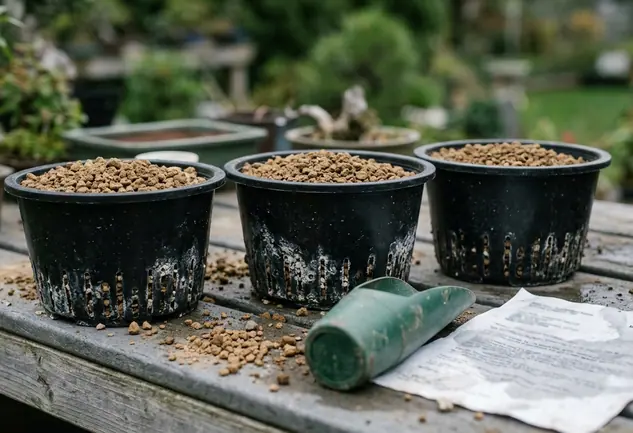
A sound comparison changes one variable at a time. Use matched containers or baskets, equal substrate volumes, and the same Akadama product and grade. Where practical, prepare a second container with the comparison substrate.
Record the Baseline
- Write down the start date, product name, grade, and stated particle range. In practical scenarios, common grades are sold as 1–3 mm, 3–6 mm, and 6–9 mm.
- Describe the initial particle condition, including visible fines and broken edges.
- Measure the pot's interior dimensions and depth.
- Record the tree species, or mark the container as an empty control.
- Describe sun, wind, rain shelter, and seasonal exposure.
- Identify the irrigation source and watering method.
Inspect Without Rebuilding the Test
Inspect at four fixed seasonal points each year in everyday practice. Photograph the same marked surface area from the same angle and height. Note water penetration, surface crust, fines leaving the drainage holes, and any change in drainage behavior.
Time drainage consistently: apply the same measured pour, then record the seconds from the end of the pour until free dripping stops. One slow result calls for another observation under comparable conditions. Consecutive intervals reveal more than an isolated drain test.
At repotting, divide the profile into upper, middle, and lower thirds. Bag material from each zone separately before washing. Surface crust beneath a California drip line is highly visible, yet it often says less about internal structure than the condition of particles in the middle and lower zones.
A rainwater comparison belongs in the protocol only where collection is legal, the catchment is clean, and the stored water suits the species. Otherwise, run the tap-water arm alone and document that choice.
Read the Pot Before Testing a Particle
Start with the least invasive evidence. Watch how quickly water enters the surface, how long free drainage continues, and whether fines appear in the runoff. At the next repot, examine root color and density and compare the top 1–2 cm with the layers below.
Protect the Evidence: Reserve finger-pressure testing for particles already removed during repotting. Weekly probing or crushing of exposed Akadama can create the damage under investigation.This sequence also prevents a common diagnostic error. A dry, mineral-coated surface can sit above intact particles, while an apparently clean surface can conceal fines compressed against the lower pot walls.
Comparing Akadama With Durable Mix Components
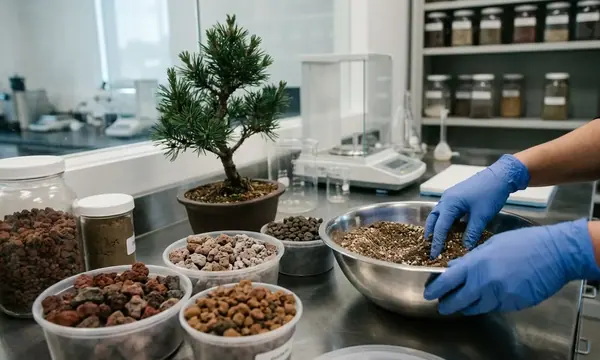
Material labels provide a starting point rather than a performance specification. Two bags sold as pumice, lava, calcined clay, or bark can differ in particle hardness, fines content, pore structure, and screening quality. Inspect each batch before mixing it into a valuable tree.
| Component | Structural behavior | Water and roots | Primary check |
|---|---|---|---|
| Akadama | Can soften or fracture over repeated cycles | Supports moisture control and fine-root ramification when the grade remains open | Track fines, drainage, and profile strength |
| Pumice | Usually offers durable porous particles | Retains water within pores while supporting drainage | Check density, fines, and batch consistency |
| Lava rock | Provides long structural life | Maintains air space but can change retention and nutrient management | Inspect sharpness, size distribution, and dust |
| Calcined clay | Performance depends on product and firing | May hold water while preserving particle form | Test wet strength rather than trusting the label |
| Aged, screened bark | Decomposes across growing seasons | Adds organic retention and changes nutrient behavior | Track decomposition separately from mineral fracture |
Pumice and lava can extend structural life, though an increased mineral fraction may require changes to watering and fertilization. Bark follows a decomposition timeline, so evaluate it across growing seasons instead of applying the particle-fracture test used for clay and mineral components.
Run One Controlled Substrate Comparison
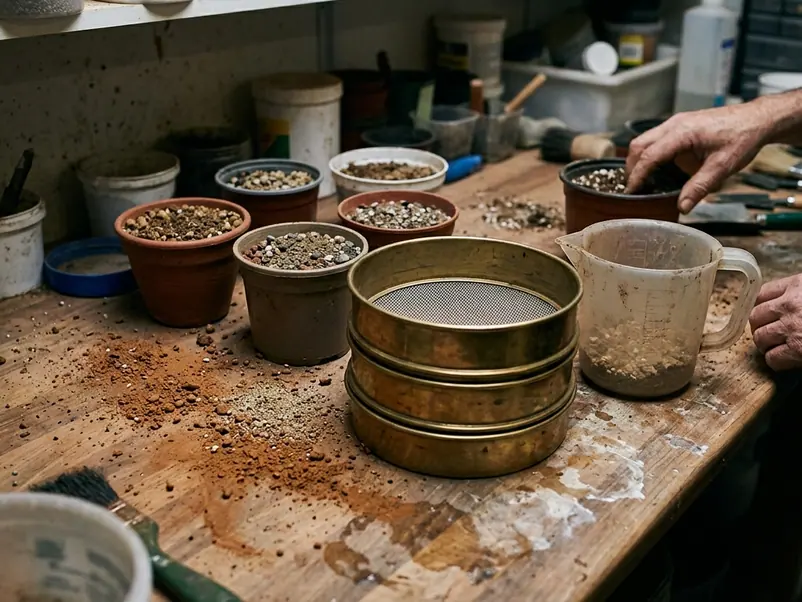
Keep a trial small enough to maintain consistently. Choose a few pots that share species, pot dimensions, particle grade, exposure, and watering schedule. Change only one factor, such as replacing part of an Akadama-heavy mix with screened pumice.
Compare particle stability, pore structure, retention, drainage rate, suitability for ramification goals, local availability, and consistency between batches. The method measures performance on a particular bench; it does not certify every product sold under the same material name.
A comparison also clarifies trade-offs. A durable mix may drain freely through several seasons yet demand more attentive nutrient management. Akadama may produce the moisture gradient and root branching sought for a refined deciduous tree, even when a coarser mineral blend would last longer.
The Practical Akadama Decision
Follow the Repot Cycle: Base the substrate decision on documented performance under the bench's water source, current reported hardness, exposure, species, pot depth, particle grade, and intended repotting interval. Retain Akadama when it delivers the desired moisture balance and root development. Modify or replace it when consecutive inspections show fines, restricted drainage, or inadequate structural life.A single mineral ring or slow watering event should trigger observation, not an immediate substrate change. Look for a repeated relationship among slower penetration, prolonged drainage, fines in runoff, and poor particle condition in the lower profile.
Two Pots on a Sacramento Morning
On a late-summer Sacramento bench, a grower waters two matched training pots before the day's heat begins driving evaporation. One holds the established Akadama mix; the other contains the single-component adjustment under review. The grower times each drain, photographs both sets of drainage holes, and writes one dated line in the bench log. The entire comparison ends before the watering round moves to the next tree.