Contents
- Why California Bonsai Need Local Timing
- Where Calendar-Only Care Fails
- Map the Climate Around Your Bench
- Use a Seven-Day Bench Log
- Adjust Watering, Repotting, and Feeding
- A Repeatable Microclimate Decision Sequence
- About This California Care Guide
Why California Bonsai Need Local Timing
A bonsai root mass sits in 4–9 cm of substrate, creating a highly reactive thermal environment that responds quickly to ambient weather. Open-ground roots below 25–30 cm experience almost no daily temperature swing, benefiting from the buffering capacity of the earth. This physical asymmetry makes traditional four-season calendars unreliable for precise cultivation and care.
Within a 30–40 km transect from the coast to the interior valleys, the same June morning can produce very different growing conditions. A coastal garden wakes up to drizzle-wet foliage and heavy marine air that suppresses transpiration. Inland benches sit under a clear sky with 8–12% relative humidity by early afternoon, driving rapid water uptake. Relying on a generic summer schedule ignores these local swings and forces trees into inappropriate wet-dry cycles. Understanding the specific microclimate of your bench prevents serious watering errors and supports root health throughout the growing season.
Where Calendar-Only Care Fails
A juniper on a coastal deck often perishes from summer drought while its foliage drips with morning fog. The top 5–10 mm of substrate reads damp at every check, but the chopstick never pushes past the second centimetre. The interior of a dense, root-bound ball stays completely dry for weeks.
Deceptive Coastal Moisture: The marine layer holds overnight and clears between 10:00 and 12:00 through June to August, creating a surface wetness that masks severe dehydration below.Inland collections face the opposite extreme during summer heat runs. Afternoon air reaches 38–42 °C, and overnight lows stay at 21–24 °C for three to five consecutive nights. This sustained heat removes the cool recovery period a fixed once-daily schedule assumes. A shohin planted in a 3–6 mm pumice-dominant mix on an exposed inland bench moves from fully saturated to genuinely needing water inside 6–9 hours on a windy 38 °C afternoon.
Blindly following a calendar can also ruin repotting efforts. Spring repotting on a printed date after an unseasonal early-May heat run raises the risk of failure. The buds have already hardened off, and the tree enters the first 38 °C week with cut roots and no sheltered aftercare space. This sequence can cause the summer decline that growers mistakenly blame on watering errors.
Map the Climate Around Your Bench
Begin by mapping the specific heat and moisture retention of the area immediately surrounding your trees. Two trident maples in the same suburban yard may require entirely different care routines based on their placement. One sits on a slatted bench against a north wall, while the other rests on a concrete patio facing west. By mid-June, the patio tree needs watering by early afternoon, and the north-wall tree requires water only every second day.
Slatted wood benches stay cooler under the pot than concrete or paving, which re-radiates heat through the evening. Dark glazed and black plastic containers on a south- or west-facing bench run noticeably hotter at the pot wall than unglazed light stoneware in the same position. Cold-air pooling also dictates placement in valley and foothill gardens on clear, still nights. The lowest bench in a walled yard sits several degrees colder than one positioned somewhere around 1.5 m higher against a wall.
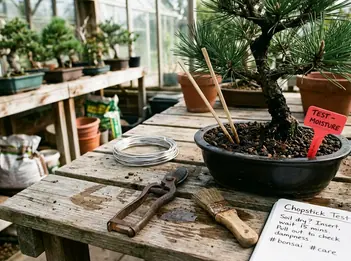
You must test the internal moisture of the rootball directly. Insert an untreated bamboo chopstick to within 1–2 cm of the pot floor, leave it in place, and withdraw it to read the colour and coolness. A dark, cool lower third means the interior is still charged with moisture.
Baseline Weight Calibration: The pot-weight test offers another diagnostic tool, though it requires establishing a personal baseline. Lift each pot immediately after watering to runoff and again close to 48 hours later so you know the weight range by hand. For trees much above 10–12 kg, the wet-to-dry difference becomes hard to feel reliably, making the chopstick reading the more useful metric.Use a Seven-Day Bench Log
Tracking environmental data over a full week can capture common weather shifts in many California settings. A seven-day span may include a fog night, a clear night, and a windy afternoon. Logging morning moisture, afternoon moisture, wind, fog duration, hours of direct sun, and any visible stress builds a profile of your bench.
Taking two readings per day for seven consecutive days separates steady dryers from trees that stay wet after foggy nights.
Isolating Bench Variables: When adjusting your setup, change only one controllable factor at a time and hold it for a full seven-day cycle before evaluating. Applying 30% shade cloth from 13:00 onward or shifting your watering routine from evening to early morning provides clear data, provided you do not make both changes simultaneously. Seven-Day Bench Log — Column Template| Day / date | Morning check (08:00) | Afternoon check (16:00–17:00) | Fog or marine layer |
|---|---|---|---|
| Monday | Pot weight heavy / medium / light, chopstick reading | Pot weight, chopstick reading | none / cleared by (time) / held all day |
| Tuesday | Pot weight heavy / medium / light, chopstick reading | Pot weight, chopstick reading | none / cleared by (time) / held all day |
Adjust Watering, Repotting, and Feeding
In mild coastal gardens, deciduous bud swell often begins between late January and late February. Interior valleys experience 35 °C-plus days starting by mid-May. This timeline leaves roughly 8–10 weeks between bud movement and severe heat for root recovery. Junipers and pines require handling later in the window than temperate deciduous species. Subtropical material, including ficus and some ulmus varieties held indoors, requires repotting when night temperatures stabilize rather than during the deciduous window.
Watering technique must adapt to these seasonal shifts. Water thoroughly to visible runoff at every drainage hole rather than applying a light surface sprinkle. A rootball that has been allowed to become hydrophobic needs a second pass 5–10 minutes after the first before the interior wets completely. Where white crusting appears on unglazed rims or surface moss browns off, leach the substrate by watering to runoff two or three times in succession rather than raising the fertilizer rate.
Winter exposure dictates different protection strategies based on elevation. Coastal benches rarely drop below -2 °C. Foothill gardens at 600–900 m see -7 to -10 °C, bringing pot-freezing protection for shallow containers into play. Subtropical species must be moved to shelter before nights settle below roughly 10 °C.
A Repeatable Microclimate Decision Sequence
Translate these observations into daily styling and pruning decisions by following a sequence in which root-zone observation precedes weather reading. A cool, heavy pot ends the decision immediately regardless of the forecast.
Under a typical coastal pattern, fog holds past 10:00 and the foliage remains wet. If the pot lifts heavy and the chopstick comes out dark and cool at depth, you verify the moisture and defer watering and feeding to the next check. The inland pattern demands a more aggressive inspection routine. Clear skies and afternoon wind leave the pot noticeably lighter by 15:00. This environment requires a second inspection at 16:00–17:00, the addition of afternoon shade or a wind break, and thorough watering only when the lower rootball reads dry.
Tomorrow morning, check one representative tree at three points — roughly 08:00, 13:00, and 17:00, and record moisture, exposure, and response for that day.
About This California Care Guide
The bonsaiexperience editorial team maintains this educational material with a focus on conservative, observation-based bonsai care. Where two readings of a tree are possible, the recommendation defaults to the less disruptive action. This guidance supports routine cultivation decisions but does not replace species-specific knowledge or direct assessment of a declining tree.
Label your first bench-log entry with four fixed fields: the tree species, the pot type and depth, the substrate mix and particle size, and the exact bench position including compass aspect.