Table of Contents
- What This Guide Covers
- Confirm the Tree You Have
- Warning: Avoid Cold, Drafts, and Latex Contact
- Choose Bright, Stable Placement
- Water by Soil Condition
- Build Humidity for Aerial Roots
- Prune for Shape and Density
- Wiring and Shaping
- Repotting and Soil
- Pests, Leaf Drop, and Recovery
- Seasonal Care Rhythm
What This Guide Covers
Ficus retusa is a forgiving tropical bonsai and a common choice for indoor growing in temperate climates. This guide covers the practical realities of keeping the tree healthy. We focus on placement, watering, humidity management, pruning, and repotting. The species tolerates early mistakes well. Refinement, however, requires consistent observation of the tree's physiological responses.
Confirm the Tree You Have
A grower purchases a bonsai labeled as Ficus retusa, only to find the foliage looks slightly different from a friend's tree. Trade labeling for indoor ficus is notoriously unreliable, with Ficus microcarpa frequently mixed into the supply chain. The practical identification traits for the common indoor trade form include glossy oval leaves typically 4-8 cm long and smooth gray bark. Because the practical care overlap between these tropical ficus forms is broad, a mislabel rarely changes your daily routine.
If your tree is destined for a botanical exhibition or breeding record, trade-level identification is insufficient. Species-level verification through resources like Plants of the World Online is required for formal documentation.
Warning: Avoid Cold, Drafts, and Latex Contact
Why do newly acquired tropical bonsai often fail within the first month? The answer usually involves temperature shock rather than a lack of water. Sustained exposure below somewhere around 12-15 C stresses these tropicals heavily. Frost damages the cellular tissue outright. Severe leaf drop after relocation often occurs within 3-10 days of the move. Keep the tree away from cold windowsills and heating vents.
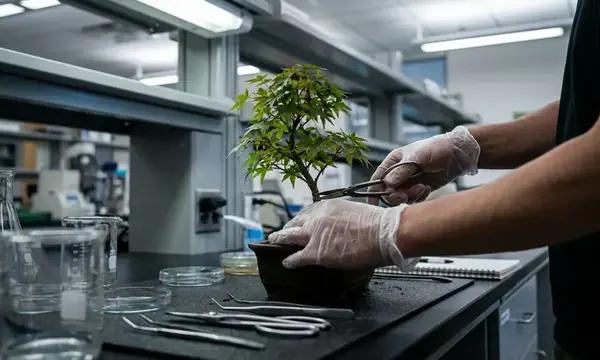
Warning: Cut ficus tissue releases a milky latex sap. Sensitive growers should wear gloves and keep this sap away from eyes, pets, and children.
Choose Bright, Stable Placement

A tree moved from a bright nursery greenhouse to a dim living room corner drops a wave of leaves within days despite correct watering. Growers often misread this as death rather than a natural light-adjustment response. Placement advice prioritizes environmental stability over maximizing light intensity. Repeated relocation and swings between bright and dim spots produce more leaf drop than a slightly dimmer but constant position.
In practical scenarios, rotate the tree roughly a quarter turn every 1-2 weeks for even canopy growth. Move the bonsai outdoors only once night temperatures stay reliably above 15 C, acclimating it to the higher light over 7-14 days.
Water by Soil Condition
A grower on an every-third-day watering schedule keeps that rhythm into low-light winter and rots the roots because the tree's uptake slowed but the calendar did not. We teach condition-based watering. Water only when the top 1-2 cm of soil begins to dry to the touch.
Lifting the pot to gauge weight gives a reliable dry-versus-saturated read once you have felt both states a few times. Thorough watering means saturating the root ball until water drains freely from the bottom holes. Never leave the pot standing in stagnant water.
Build Humidity for Aerial Roots
How do you encourage the dramatic banyan-style aerial roots Ficus retusa is known for? Misting produces brief surface wetness that evaporates too fast to sustain root initiation. Aerial roots are encouraged by overall tree vigor and steady ambient humidity. Guiding tubes or humidity trays with water kept below the pot level offer better results than a spray bottle.
Aerial roots that reach the soil generally need several months of active growth before they visibly thicken and contribute structurally.
Practical tip: Wrapping a trunk in constantly saturated sphagnum moss for long stretches can soften the bark and invite rot, so keep any guiding material damp rather than sodden.
Prune for Shape and Density

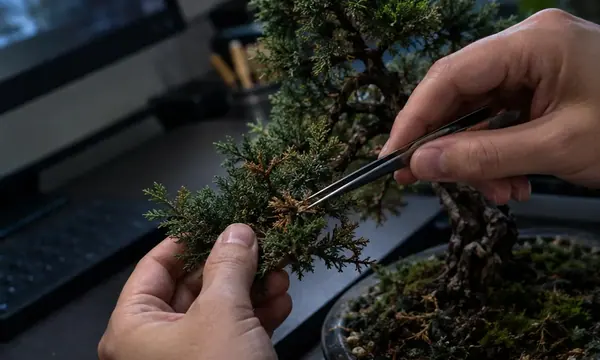
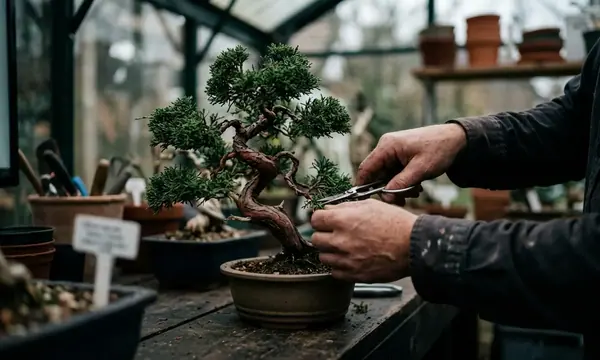
A beginner attempts heavy silhouette cuts during the same period as routine pinching, stalling the tree's momentum. Separating structural pruning from maintenance pruning clarifies timing and intensity. Maintenance pruning manages energy distribution. Typically, you let a shoot extend to 6-8 leaves, then cut it back to 1-2 leaves depending on the vigor of that specific branch.
Structural cuts remove crossing branches, overly thick vertical shoots, and weak interior growth. Directional cutting serves as the primary shaping method because the dense ficus canopy responds predictably to targeted removal.
Wiring and Shaping
Pruning dictates the primary shape, while wire is reserved for placing branches that cutting alone cannot reposition. Grower observations suggest dense tropical canopies often fill out faster when allowed to grow unhindered by heavy wire wraps. During strong summer growth, check applied wire every 1-3 weeks.
A fast-thickening summer shoot can begin marking within a few weeks. The same wire on a slow-growing winter branch causes no marking for months.
Repotting and Soil
When is the optimal time to repot an indoor ficus? Repotting timing is tied to observed vigor rather than a specific calendar month. A warm, actively growing ficus regenerates roots quickly. The same operation on a slow or stressed tree stalls recovery.
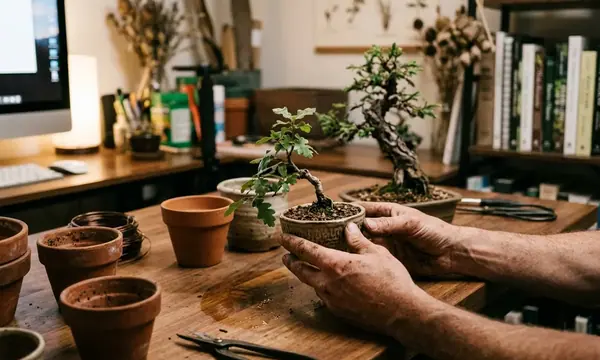
Reduce the compacted root mass conservatively, removing on the order of a third of the mass at most on a healthy, vigorous tree. Repotting is best undertaken during the warm active-growth window. The exact repotting interval depends on growth rate, pot size, soil breakdown, and climate, meaning no fixed year count applies across collections.
Pests, Leaf Drop, and Recovery
A grower notices scale insects and immediately prunes the tree hard to remove the infestation, inadvertently removing the foliage generating the energy needed for recovery. The recovery sequence must deliberately correct placement and watering before any pruning occurs. Inspect leaf undersides and branch junctions where scale and mites first concentrate.
Delay heavy pruning until new growth appears, which is often 2-6 weeks after conditions are corrected. New growth is the only reliable signal that the tree has stabilized enough to tolerate cutting.
Post-Acquisition Stabilization Checklist
- Set one bright, stable position and stop moving the tree.
- Water only when the top 1-2 cm of soil begins to dry.
- Inspect leaf undersides, branch junctions, and soil surfaces for pests.
Seasonal Care Rhythm
The indoor calendar is framed around tropical growth rather than true dormancy. An indoor ficus rarely experiences a genuine rest period. Care is adjusted to observed slowing when light and warmth decrease.
As daylight shortens, watering frequency commonly drops by roughly half compared with peak summer. Track this shift by soil condition rather than the calendar.
Troubleshooting reminder: When troubleshooting a declining Ficus retusa, practice single-variable correction. Growers under pressure tend to change several things at once, which obscures exactly which factor was limiting the tree's health.