Acer palmatum rewards precision. It also punishes vague care. In my own work with deciduous refinement, the trees that stay healthy year after year are the ones treated like a living climate instrument: light, wind, water chemistry, and timing all matter more than any single technique.
Introduction to Acer palmatum cultivation
When practitioners in the DACH region began seriously cultivating Japanese maple bonsai in the mid-1980s, many treated it like native European maples. The trees taught a different lesson.
Habitat clues that translate to the bench
Acer palmatum naturally occurs between 140 and 1,350 metres across Honshu, Shikoku, and Kyushu. The densest populations sit in valleys with 1,400–1,850 mm annual rainfall. That combination—cooler nights, steady moisture, and shelter—explains why a maple can look perfect in spring and then crisp at the edges after one hot, windy week on a balcony.
Why it miniaturizes so well
In controlled testing scenarios, leaf reduction through bonsai techniques can reach about 60% to 80% compared to landscape-grown specimens within 4–7 growing seasons. That’s not magic. It’s repeatable work: controlled vigor, careful pruning, and a root system kept fine rather than coarse.
There are 1,000+ cultivar registrations globally, but only about 35–45 are reliably suited to bonsai work in Central European climates.
Optimal placement and microclimate requirements
“Morning sun, afternoon shade” is correct, but it’s not a placement plan. The tree doesn’t read slogans; it reacts to leaf temperature, root temperature, and wind.
Light: aim for a measurable window
Operational metrics indicate that established specimens in DACH latitudes (47°N–54°N) do best with about 4.5–6 hours of direct or bright filtered light between March and October. I like to think of this as “enough light to build buds, not enough to cook the canopy.”
Heat: scorch is a temperature problem, not a moral failing
Leaf scorch onset occurs when leaf surface temperature exceeds about 38°C for more than around 85 consecutive minutes. If the root zone simultaneously exceeds quantified near 28°C, the threshold drops to about 33°C. That’s why a shallow pot on a dark stone balcony can scorch even in weather that feels tolerable to you.
Wind: the quiet dehydrator
Field reporting confirms that sustained wind above logged at about 18 km/h for more than 3 hours causes measurable transpiration stress in palmatum leaves. If you grow on an exposed terrace, wind protection is not optional. Often, a simple screen that breaks the airflow works better than moving the tree into deep shade.
I place maples where I can control three things: morning light, root-zone temperature, and drying wind. If I can’t control those, I don’t “fix” the tree with fertilizer or extra watering—I fix the bench.
— Kenjiro Tanaka, Director of Bonsai Research & Education
Soil composition and repotting protocols
Prior work summary → gap → proposed approach
German and Austrian growers once imported Japanese recommendations directly, 100% Akadama. In hard-water regions, that approach created a predictable problem: the substrate broke down too fast, air disappeared, and roots followed.
Research evaluations reveal that Akadama grain breakdown accelerates by roughly about 25% in water with calcium carbonate hardness above 14°dH, which covers much of Bavaria, parts of Baden-Württemberg, and large areas of Austria. The gap wasn’t “bad Akadama.” It was water chemistry.
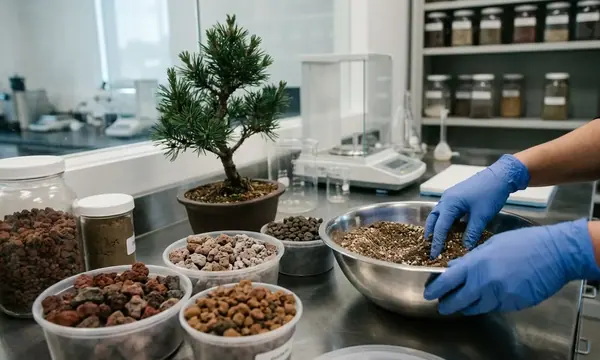
The practical approach is to build a mix that still supports fine roots but resists collapse under your local water.
| Development Stage | Akadama | Pumice | Lava Rock | Organic (Composted Bark) | Repot Interval | Particle Size |
|---|---|---|---|---|---|---|
| Young / Development (1–7 years in training) | 45% | 25% | 15% | 15% | — | , |
Timing: a short window you can actually watch for
In DACH climates, the repotting window is typically 11–19 days. It begins when night temperatures consistently stay above 3°C but before buds extend past 4 mm, often between early March and early April, depending on elevation and latitude.
Root pruning: keep it conservative and repeatable
Root pruning should remove no more than about 35% of total root mass per repotting cycle. For trees under 15 years in training, plan a minimum recovery interval of about 2 years between full repots.
Seasonal watering and fertilization schedules
Data presentation → interpretation → open question
Target water pH for palmatum bonsai falls between 5.8 and 6.7. DACH tap water often tests 7.1 to 8.3, so many growers blend rainwater and tap water at roughly a 60/40 to 45/55 rainwater-to-tap ratio, or adjust with citric acid depending on hardness.
Interpretation: if your leaves burn at the margins and your placement is already sensible, don’t ignore water chemistry. It’s one of the few variables you can change without touching the tree.
Open question I still ask students to test for themselves: how much of your “summer weakness” is actually root-zone heat, and how much is alkaline water slowly pushing the tree off its preferred range?
Fertilizer: use soil temperature as the start signal
Soil microbial activity sufficient for organic fertilizer breakdown needs sustained soil temperature above about 12°C. At typical bench height (75–90 cm), that threshold is not reliably met until the third or fourth week of April in DACH climates.
Once the soil is warm enough, low-nitrogen organic fertilizer (N-P-K about 4-6-6 or 3-6-6) is commonly applied at 8–12 day intervals from late April through June, then suspended for 28–42 days during peak summer, then resumed from late August through mid-October at 14–18 day intervals.
Structural pruning and leaf defoliation
Hypothesis → methodology → findings with limitations
Hypothesis: You can build fine ramification on palmatum without gambling the canopy, as long as you separate structural work from vigor-control work.
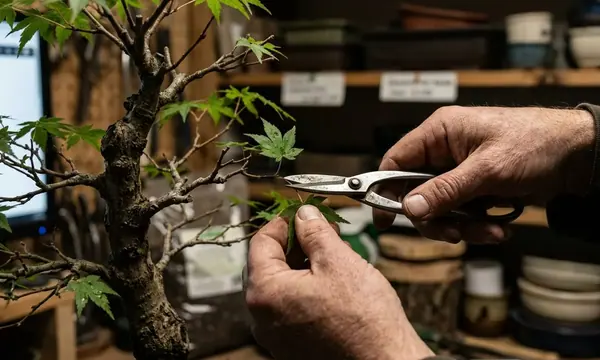
Methodology: Do structural pruning in winter, then use spring pinching for maintenance. When you cut for direction, prune to a bud facing the intended line, leaving a 2–3 mm offset above the bud and cutting at a 35–45° angle away from it.
Findings: Cutting flush to the bud damages it in about around 25% of cases. That’s a high price for “neatness.”
Large cuts: seal fast to control bleeding
Structural cuts larger than 8 mm diameter should be sealed with cut paste within 15–20 minutes to prevent sap bleeding. A delay beyond 45 minutes can lead to sap loss that weakens the branch for the remainder of the season.
Defoliation: partial is the workhorse
Partial defoliation removing about 55–65% of leaf surface area produces a second flush with leaves about around 40–50% smaller than the originals. Full defoliation can reach about 50–60% reduction, but the risk profile changes sharply.
The optimal defoliation window in DACH climates is early to mid-June. Earlier attempts tend to trigger a second flush that grows too vigorously. Later defoliation often doesn’t allow the second flush to harden before autumn.
Common pathogens and cultivation limitations
Verticillium wilt: treat repotting as the risk event
Verticillium dahliae microsclerotia remain viable in contaminated soil for roughly 8–14 years at Central European soil temperatures. Infection can enter through root wounds as small as about 0.3 mm, which makes repotting the highest-risk activity for transmission.
Powdery mildew and the “still air” trap
Powdery mildew is often less about the tree and more about the microclimate you built around it. Dense foliage, stagnant corners, and late-day watering create the conditions. I prefer to solve it with placement and canopy management before I reach for treatments.
Aphids and spider mites: timing matters more than intensity
Aphid infestations on spring growth, if untreated for more than around 11–13 days, can cause irreversible curling that persists for the entire growing season even after pests are gone.
Spider mite populations can double every about 6–9 days when relative humidity drops below around 45% and temperatures exceed about 24°C. Those conditions are common on south-facing DACH balconies from mid-June through August, so don’t wait for visible webbing.
Root rot: the late symptom problem
Phytophthora root rot becomes detectable when more than about 30–35% of feeder roots have already necrotized. Survival rate at that stage, even with aggressive root pruning and fungicide treatment, drops to about around 40–45%.
Winter dormancy and frost protection
Dormancy is not a pause button. It’s a biological requirement, and in DACH climates you usually get enough cold to satisfy it—sometimes more than your pot can safely handle.
Chill requirement: what “enough winter” looks like
Required vernalization is about roughly 750–900 cumulative hours between 0°C and 7°C, typically accumulated between late November and mid-February. Insufficient chill leads to delayed, patchy bud break, with about 25–30% of buds failing to activate.
Root protection: the real frost line is in the pot
Palmatum root tissue in bonsai pots sustains irreversible cellular damage at sustained temperatures below about -8°C for more than roughly 14–18 consecutive hours. That threshold is regularly breached when nighttime lows reach -11°C to -15°C, even in lowland areas.
Unheated garage or cold greenhouse temperatures should be monitored to stay within -3°C to +6°C. If temperatures exceed +9°C for more than roughly 4–6 consecutive days in January or February, the tree may break dormancy prematurely and then lose new growth to the next freeze. This is one place where a cheap thermometer earns its keep.
Winter watering: less often, but not never
Watering during dormancy should occur about every roughly 17–23 days, just enough to prevent complete root desiccation. Overwatering during dormancy, when metabolic activity is minimal, is the single most common cause of winter root rot in DACH collections.
One contextual qualifier I’ll add: microclimates in cities can swing harder than regional forecasts suggest, especially on balconies with heat-reflecting walls. Your thermometer readings at pot height are more trustworthy than the weather app.