What's Inside
- Mechanism, not shortcut
- Energy sources and sinks
- Hormones and bud release
- The timing window
- Ramification versus vigor
- Species response
- When to skip it
- Safe defoliation method
- Final decision frame
Defoliation is not simply leaf removal. In bonsai refinement, it is a controlled stress technique used to influence bud activity, internode length, and vigor distribution on trees already strong enough to answer that stress with new growth.
The useful question is not, “What month should I defoliate?” The better question is, “Does this tree have enough stored energy, active growing weather, and viable buds to make the cut worthwhile?” A vigorous trident maple in early summer may push a tidy second flush with shorter internodes. A Japanese maple recovering from a spring repot may stall and lose interior branches after the same treatment.
Defoliation is best treated as a decision process. Full, partial, and selective defoliation each carry different levels of risk, and the right choice depends on species, season, tree strength, and the refinement goal.
Why Defoliation Is More Than Leaf Removal
Defoliation works only when the tree can replace what you take away. Leaves are not decoration; they are the primary organs producing the carbohydrates that support new shoots, roots, callus, and stored reserves.
In practice, the technique asks the tree to spend energy now in exchange for structural refinement later. That exchange can be useful on an established bonsai with dense outer foliage and strong shoot extension. It can be wasteful on material still building trunk thickness or primary branches, where raw growth is more valuable than fine twigging.
The common mistake is to treat defoliation as a seasonal chore. It is better understood as a refinement intervention. A tree either meets the conditions for that intervention, or it does not.
Key Takeaway: Defoliation should begin with a health and purpose check, not with a calendar date.Energy Redistribution After Leaf Removal
Think of a bonsai as a network of sources and sinks. Mature leaves act as sources because they make carbohydrates through photosynthesis. Developing buds, extending shoots, new leaves, roots, and healing tissue act as sinks because they consume that energy.
When you remove leaves, you reduce the tree’s current ability to earn new carbohydrates. The tree must then draw on stored reserves in roots, wood, and branches to produce replacement growth. A hardened first flush typically represents several weeks of accumulated photosynthate before removal is even considered.
This is why two trees of the same species can respond very differently. One has a well-fed root system and branches loaded with reserves. The other has already spent heavily through repotting, pest recovery, or structural pruning.
The second tree is not being stubborn. It is short on budget.
A tree with depleted reserves after a heavy growing season or recent structural pruning will spend rather than redirect energy, and refinement gains may not appear. In that situation, restraint is the more advanced technique.
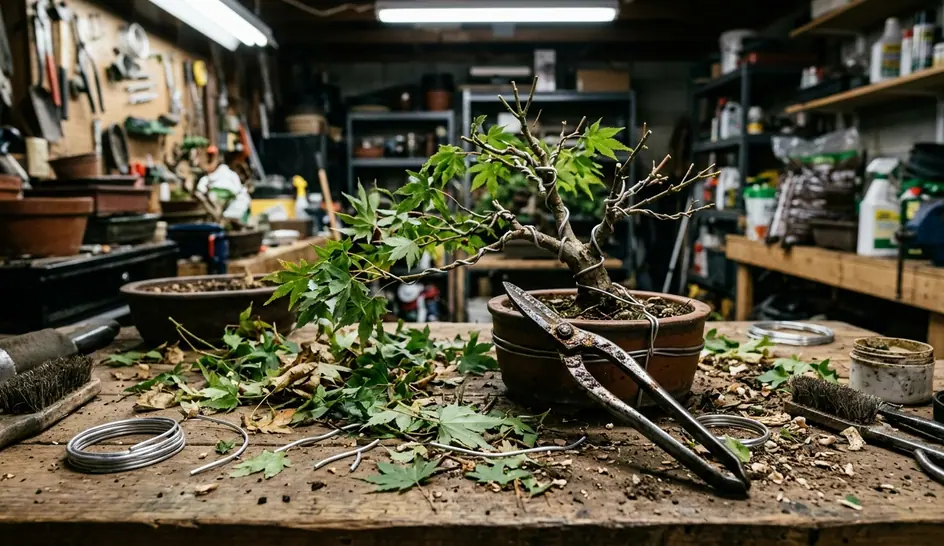
Hormones, Apical Dominance, and Bud Release
Why does removing a leaf sometimes wake a bud near its base? The answer sits partly in hormonal signaling, especially the relationship between auxin and cytokinin.
Shoot tips and expanding leaves participate in auxin-related apical dominance. In simple terms, strong growing tips can suppress weaker buds behind them. Cytokinin-supported bud activity helps explain why dormant or latent buds may begin moving once that suppressive balance changes. For readers who want the plant physiology background, the paper on shoot branching hormone control provides a useful scientific frame.
For bonsai work, the practical point is narrower: defoliation does not create buds from nothing. It can only encourage viable dormant or latent buds to move when the branch is alive, supplied, and positioned to receive light.
I do not expect a shaded, weak inner shoot on a tired maple to become a strong branch because its leaf was removed. I first ask whether that branch already has the biological means to respond.
The Timing Window That Matters
The safest timing cue is visual, not monthly.
Has the first flush hardened? Are the leaves firm rather than tender? Has their color deepened? Are the shoots slowing extension and beginning to lignify? These signs matter more than the name of the season because climates differ sharply between regions.
Warning: If the tree is already protecting itself from heat, dry roots, or insects, leaf removal adds stress to stress. Wait until the tree is growing cleanly and evenly.The reliable window opens once the spring flush has hardened and closes well before shoots would normally slow for the season. In many workable situations, this leaves roughly six to eight weeks of active growing weather for a second flush to harden. Regions with short warm seasons have a narrower usable window.
Do not defoliate during extreme heat, drought stress, active pest pressure, or just before dormancy. Late defoliation often creates soft growth that cannot mature properly before cold weather. The tree then pays the cost without gaining a durable structure.
Ramification Gains and Vigor Costs
Defoliation can improve ramification because the replacement flush often emerges with smaller leaves, shorter internodes, and increased bud activity near the cut petiole. That is the attraction.
The cost is real. Each new flush spends stored energy and growing time. On an established bonsai, that trade may serve the design. On undeveloped material still being grown for trunk or primary branch size, it slows the growth you actually need.
Full, partial, and selective approaches
- Full defoliation: Removes all suitable leaves from the tree. Use it only on vigorous, established specimens with a clear refinement goal.
- Partial defoliation: Removes a portion of each leaf or selected leaves across the canopy. This keeps some photosynthetic capacity in place.
- Selective defoliation: Targets strong zones while leaving weak branches more heavily foliated.
Selective work is often the better field choice. Remove more leaves from strong outer or upper areas and fewer from weak inner or lower areas. That approach can reduce dominance where the tree is too strong while preserving energy where the design still needs support.
Species Responses Are Not Equal
Start with the species group, then judge the individual tree.
Trident maple often responds strongly when healthy and warm, making it a common candidate for careful partial or full defoliation in refinement. Japanese maple can respond well too, but it is less forgiving when weak, recently repotted, or exposed to intense sun after leaf removal. Chinese elm usually tolerates selective leaf reduction when actively growing. Hornbeam can be useful in refinement but should not be pushed casually. Beech deserves restraint; its growth rhythm and bud behavior make aggressive defoliation a poor default.
Many ficus species tolerate stronger leaf reduction under warm, bright, actively growing conditions. The same tree indoors under weak winter light may produce sparse, leggy regrowth because light, not leaf count, is the limiting factor.
Pines do not belong in this broadleaf defoliation logic. They are managed through candle work, needle control, and species-specific timing. Stripping needles to imitate maple defoliation is a category error.
Even within a tolerant species, health and local conditions override the category. Treat species response as a starting point, not permission.
When Defoliation Should Be Skipped
Some trees should keep every functioning leaf they have.
- Recently repotted trees
- Recently collected trees
- Pest-weakened trees
- Drought-stressed trees
- Trees recently subjected to heavy wiring, bending, or structural pruning
- Young trees still being grown for size
- Trees in poor light or unsuitable growing conditions
A repotted tree generally needs a full growing season of recovery before it can afford the energy cost of defoliation. That recovery period matters because new roots must rebuild the tree’s capacity to take up water and support renewed shoot growth.
Warning: Do not use defoliation to force vigor into a weak tree. Build strength first through light, watering discipline, root recovery, and steady seasonal growth.Defoliation is also not a cure for poor light, poor watering, weak roots, or unsuitable species selection. If those limits remain, leaf removal only exposes them faster.
A Safe Defoliation Method for Refinement Work
Begin with pre-checks before tools touch the tree. The tree should be actively growing, well rooted, pest-free, hydrated, and past the tender first-flush stage. The weather ahead should offer warm, bright conditions long enough for replacement growth to harden.
Step-by-step field method
- Define the purpose. Decide whether you want shorter internodes, interior bud activity, smaller leaves, or vigor balancing.
- Mark weak areas mentally. Preserve more foliage on inner branches, lower branches, and any shoot that supports a needed design line.
- Work by strength, not symmetry. Strong branches can lose more leaf area; weak branches should keep more.
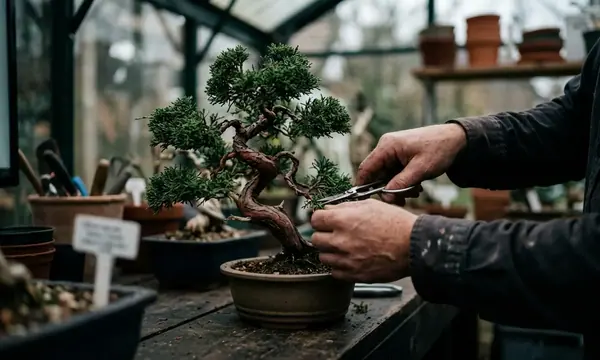
- Cut the leaf, not the bud. Leave a short petiole stub to protect the axillary bud at its base. The stub dries and usually drops on its own in the neighborhood of one to two weeks.
- Keep aftercare quiet. Avoid heavy fertilizing surges, hard pruning, or additional styling immediately after defoliation.
- Watch the response. A healthy response shows a second flush emerging within roughly two to four weeks under warm, bright conditions.
Clean scissors help, but judgment matters more than the tool. Work slowly enough to see which branches are carrying the design and which branches are simply strong.
Pro Tip: Before cutting, identify the weakest useful branch on the tree. Let that branch set the pace for the whole operation. If it cannot afford defoliation, the tree may need selective work rather than a full treatment.The Final Decision Frame
Defoliation earns its place when the expected structural benefit outweighs the biological cost. That is the whole decision in one sentence.
Use the technique on established trees with strong roots, hardened foliage, and enough season left for a second flush to mature. Prefer selective or partial defoliation when you are learning a tree’s response. Reserve full defoliation for vigorous specimens with a clear refinement goal and a history of strong recovery.
The conservative rule is simple: do not defoliate a tree that is already trying to recover from something else.
In deciduous refinement, the leaf you leave can be as important as the leaf you remove. Strength must remain where the future branch is needed.
— Kenjiro Tanaka, Director of Bonsai Research & Education