What's Inside
- Plan around exposed bonsai roots
- Avoid one winter method for every tree
- Identify your tree category
- Choose a sheltered winter site
- Build a simple cold frame
- Mulch the pot, not the trunk
- Water, vent, and inspect through winter
- Know when to ask local help
- Restart gradually in spring
- Check the reference
Caring for bonsai through winter is less about keeping a tree warm and more about keeping it stable. The container is the vulnerable part. Once you understand that, cold frames, mulch, and winter watering start to feel practical instead of mysterious.
Why First Bonsai Need Winter Planning
A bonsai in a shallow pot does not experience winter like the same species planted in the ground. Ground soil loses heat mainly from the surface. A bonsai root ball sits exposed through the pot walls, the bottom, and the top, so air temperature reaches it from nearly every direction.
That difference matters most during sharp cold, drying wind, and repeated thawing. Shallow bonsai containers hold a root ball only a few centimeters deep, so soil in a pot can track air temperature within hours rather than shifting slowly like ground soil. A tree may look protected because its branches are wrapped, while the pot is standing on a paving slab where the root ball freezes hard through the container walls.
The beginner goal is simple: keep hardy outdoor bonsai dormant, cold, and protected from extremes. Do not aim for spring in January.
This guide uses a conservative method: identify the tree category, choose a sheltered site, build or adapt a simple cold frame, mulch around the container, check moisture during mild spells, and bring the tree back out gradually in spring.
Warning: Do Not Treat All Bonsai Alike
Warning: Tropical, subtropical, temperate deciduous, temperate evergreen, and hardy conifer bonsai do not share one winter plan. The fastest way to lose a first tree is to copy a method meant for a different climate group.
Tropical and subtropical bonsai suffer damage once temperatures approach freezing. They do not belong in an unheated cold frame that can drop to the surrounding outdoor low. They usually need bright indoor protection instead, with care adjusted for indoor light and air movement.
Temperate bonsai create the opposite problem. Bringing a hardy deciduous or conifer bonsai into a heated living room can interrupt dormancy. The tree may respond to warmth, begin moving too early, and then meet weak light, dry indoor air, or a later freeze when moved again.
I treat this as a sorting step, not a styling preference. Before choosing a site, decide whether the tree needs to stay above freezing indoors or stay cold and dormant outdoors.
Step 1: Identify Your Tree’s Winter Needs
What kind of winter does your tree expect?
Start with the species if you know it. If you do not, sort the tree into a broad category: temperate deciduous, temperate evergreen, hardy conifer, tropical, or subtropical. That category gives you a safer first decision than a calendar date.
Local winter lows matter, but they are not the only factor. Wind exposure, pot size, soil mix, and recent repotting can shift the correct protection level. A newly repotted tree that lost significant root mass in the current growing season should be treated as one hardiness step less tolerant until it has rebuilt roots over a full season.
Very small shohin pots need special attention. A shohin pot holding well under a liter of soil and a large training pot in the same frame do not face the same risk; the tiny pot freezes through much faster and belongs in the most buffered corner.
The USDA Plant Hardiness Zone Map is a useful starting reference for outdoor hardiness. Use it as a floor, not a promise. Official hardiness-zone data describes in-ground survival, while bonsai roots in containers face harsher temperature swings.
Winter Method by Bonsai Category
Winter protection choices for common beginner bonsai categories| Category | Cold frame or freezing site? | Primary winter goal | Key risk to watch |
|---|---|---|---|
| Temperate deciduous | Yes, in a sheltered cold frame or equivalent outdoor protection | Hold dormancy cold and stable | Exposed pot freezing through; drying wind |
| Temperate evergreen | Usually yes, with wind and sun moderated | Keep roots protected while foliage avoids winter desiccation | Drying wind and bright winter sun |
| Hardy conifer | Yes, if the site buffers sharp lows and wind | Maintain dormancy without rapid freeze-thaw swings | Container root exposure and winter drying |
| Tropical or subtropical | No freezing cold frame | Protect above freezing under bright indoor light | Cold damage as temperatures approach freezing |
Step 2: Choose a Sheltered Winter Site
A south-facing wall often feels like the kind choice because it is warmer. In practice, it can be hard on dormant bonsai. Winter sun may thaw the pot during the day, then the root ball refreezes at night.
A north or east-facing wall is often safer for hardy dormant trees because it reduces those swings. The best winter site is not the warmest spot on the property; it is the place that stays cold, sheltered, and steady.
Aim to keep hardy dormant trees in a range that stays cold enough to hold dormancy, roughly at or just above the frozen mark on mild days and buffered from the sharpest overnight lows. Shade or partial shade helps slow premature bud movement, especially during sunny spells late in winter.
Beginner Site Options
- Against a north or east-facing wall: A practical choice when the wall blocks wind and roof runoff does not dump water or ice onto the trees.
- Inside an unheated garage: Useful during hard cold if you can monitor light, temperature, and soil moisture. Do not forget the trees just because they are out of sight.
- Under a bench with a windbreak: Good for grouped hardy trees when drainage remains open and rodents cannot settle in undisturbed.
- In a simple cold frame: The most controlled beginner option when you need to buffer wind, rapid temperature shifts, and direct exposure.
Check five things before settling on a site: wind protection, drainage, access for watering checks, rodent protection, and distance from roof runoff. If one of those is poor, fix it before the first hard freeze.
Step 3: Build a Simple Cold Frame
A bonsai cold frame is not a heated greenhouse. Its purpose is to soften the edges of winter: less wind, fewer abrupt temperature swings, and less direct exposure on the pot.
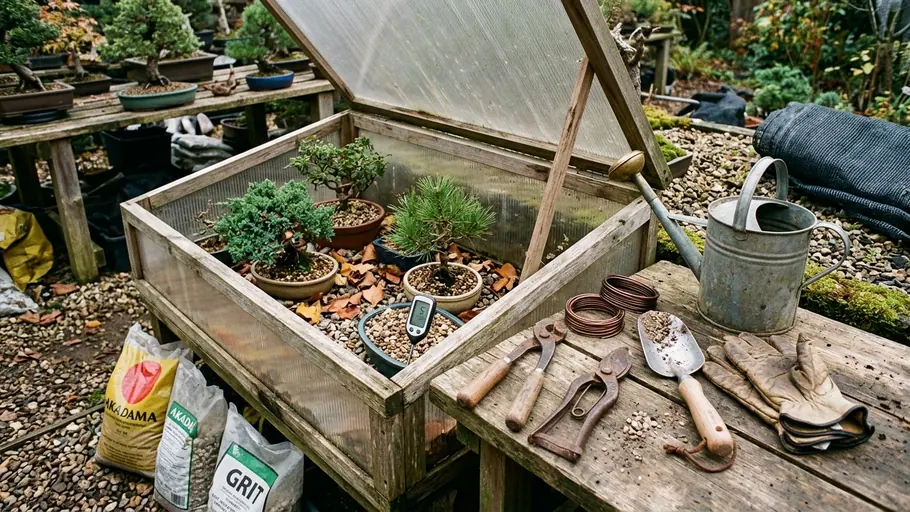
Gather Cold Frame Materials
- Untreated lumber or rigid boards for the sides
- Clear polycarbonate or an old storm window for the lid
- Bricks or blocks to steady the frame
- Coarse gravel for the base
- Pine bark mulch or another loose insulating material
- A small thermometer placed where you can read it easily
Set the frame on a base of coarse gravel so meltwater drains away rather than pooling around the pots. Drainage is not decorative here; wet, trapped conditions make winter problems harder to read.
Set Pots, Mulch, and Lid
- Level the site so pots do not tip during storms or thawing.
- Add coarse gravel across the base.
- Arrange bonsai pots together, placing the smallest or weakest trees in the most buffered position.
- Surround the pots with mulch, keeping the trunk bases clear.
- Place the clear lid so it sheds rain but can be opened easily.
- Use bricks or blocks to hold the frame steady in wind.
Do not seal every gap. Ventilation belongs in the design from the start. Prop the lid a few centimeters on calm, mild days when sun could heat the interior, then close it before hard freezes or drying winds arrive.
Tip: Mulch the Pot, Not the Trunk
Pro Tip: Insulate the container and root zone, but keep the nebari, trunk flare, and lower branches visible.
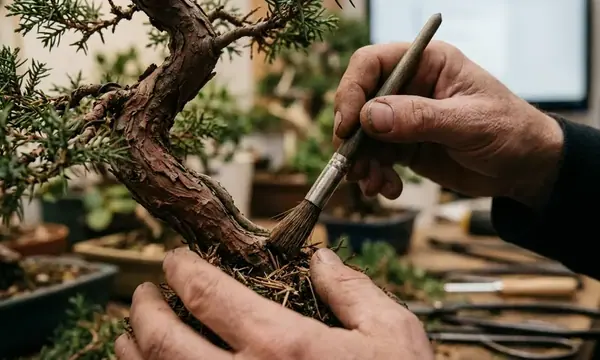
Pack mulch around the outside of the pot and up to the soil surface. Leave the trunk base able to breathe and dry. Mulch pressed against bark can hold moisture where you least want it.
Pine bark, wood chips, straw, or dry leaves can all work. Leaves need a closer eye because they can mat down and hold excess moisture. After a storm or strong wind, recheck the frame; one gust can shift mulch and leave one side of a pot bare to the cold.
Step 4: Water, Vent, and Inspect Through Winter
Dormant bonsai still need moisture. Dormancy reduces demand; it does not turn roots into dry storage.
Check soil moisture on days when temperatures rise above the frozen mark. Use a chopstick or your finger at the edge of the pot, where you can test without disturbing the trunk base. Water only if the root ball is genuinely drying, not frozen solid.
If the mix is frozen, wait. Water applied to frozen soil cannot move through the root ball normally, and it can leave ice where air should return later.
Vent the frame after sunny mild spells to release trapped humidity and heat before they build over consecutive bright days. Then close the lid again before hard freezes or drying winds. This small rhythm matters more than a fixed weekly schedule.
- Look for shifted mulch.
- Check that pots still drain freely.
- Watch for rodent activity around sheltered corners.
- Confirm that the lid remains secure but movable.
Know the Limits of This Beginner Method
This approach fits common hardy outdoor bonsai in containers during a first winter. It does not cover tropical indoor care in detail, commercial bulk storage, or specialized alpine protection.
One catch deserves plain language: microclimate, species, pot size, soil mix, and recent health can each shift the right choice. If a tree is valuable, weak, newly collected, recently repotted, or simply uncertain, ask a local bonsai club, experienced grower, or extension resource before relying on this method alone.
Spring Restart: Stability Beats Warmth
The same rule that protects bonsai in winter protects them in early spring: avoid sudden swings. Buds that have started moving are tender, and a tree pulled from a protected frame into bright wind can lose moisture quickly.
Remove mulch in stages over successive mild spells rather than all at once. Open the frame more often as weather settles. Keep late-freeze protection ready until buds are clearly moving and the risk of hard frost has passed.
Key Takeaway: For hardy bonsai, winter care is not a search for warmth. It is a plan for cold, sheltered, evenly managed dormancy.