What's Inside
- Symmetry as a trap
- Why clean geometry can mislead
- Asymmetry as design discipline
- Practical application
- Where symmetry still helps
- Final design test
- Author’s perspective
The Triangle Is Not the Tree
I have become cautious around mathematically perfect triangular bonsai because they often look arranged rather than alive.
That does not mean the triangle has no value. A triangular silhouette gives beginners a clear way to understand branch hierarchy, mass, and visual balance. It helps a new stylist see why the first branch often carries more weight, why the apex should relate to the trunk, and why a tree needs a readable outline from the chosen front.
The problem begins when the teaching tool becomes the design goal.
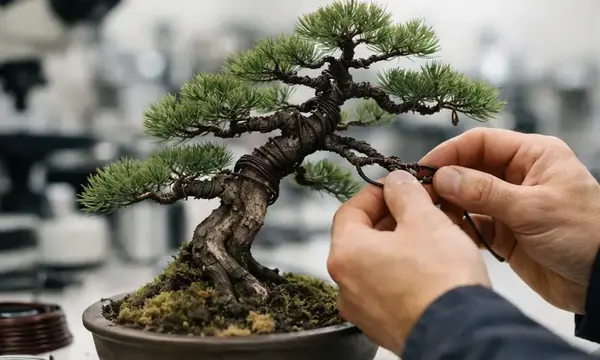
A juniper with dramatic trunk movement, for example, can lose its force when the apex gets pulled back to the center only because the triangle demands it. The trunk leans, twists, and tells one story, while the foliage answers with a polite geometric correction. The result may be clean, but clean is not always convincing.
This piece assumes you already understand basic styling conventions: front selection, primary branch placement, and the idea of visual weight. If you are styling your first tree, the triangle may still serve you well for a while. For more developed material, especially trees with strong character, I prefer to treat the triangle as scaffolding rather than architecture.
Why Perfect Symmetry Feels Safe—and False
Why do so many of us reach for symmetry when we feel uncertain?
Because symmetry gives quick answers. It tells you whether the left side matches the right. Instructors get an easy language during critique. The hand holding the shears feels reassured, especially when a cut feels irreversible.
In workshops, the first comments often land on structure and proportion. That makes sense. A tree with no order is hard to refine. But mature styling decisions rarely deserve to be settled in one session; they need repeated observation as the tree responds through later pruning, wiring, and growth.
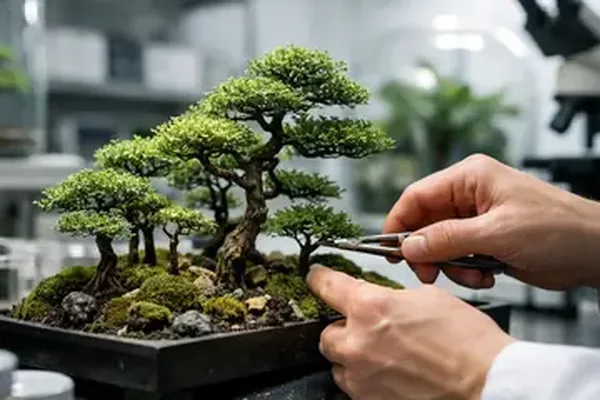
Over-symmetrical bonsai usually reveal themselves before you inspect the details. The left and right branch pads carry equal weight. Pads sit at evenly measured intervals, like shelves. The apex sits predictably over the trunk base, even when the trunk movement argues against it. The silhouette starts to resemble a template.
Here is the practical danger: once you begin correcting every irregularity, you can prune away the tree’s best sentence.
Warning: Do not confuse tidy foliage with resolved design. A bonsai can have neat pads and still feel static if every branch exists mainly to satisfy geometry.
What Natural Asymmetry Actually Requires
Asymmetry is organized imbalance. It is not permission to place branches wherever they happen to grow.
A convincing asymmetrical bonsai still needs discipline. It needs visual weight, negative space, directional movement, and a readable front. The viewer should sense intention even when the left side and right side do not match.
I usually look at five design levers before I touch the branch cutter:
- Off-center apex: The apex should answer the trunk’s movement, not merely sit above the base like a roof peak.
- Unequal branch mass: One side may carry the stronger visual load while the other side provides restraint, echo, or open space.
- Varied pad spacing: Natural rhythm rarely comes from equal intervals. Closer spacing can create density, while wider gaps can create breath.
- Open spaces near the trunk: Negative space lets the trunk speak. Without it, the tree becomes a green object rather than a bonsai.
- Directional flow: Foliage should follow, resist, or complete the trunk line in a deliberate way.
Species matters here. A deciduous tree pruned into a dense evergreen-style triangle often loses the open winter ramification and seasonal rhythm that give it character. A juniper can tolerate bolder masses and sharper negative spaces. A native oak may ask for a heavier, more irregular crown. The principle stays steady, but the expression changes.
This is design interpretation, not universal doctrine. Exhibition context, school lineage, and species habit can justify different degrees of order. Asymmetry must never become an excuse for weak branch selection or a confused silhouette.
Tip: Use the Triangle, Then Break It
Here is the method I use with students who understand the triangle but cling to it too tightly: build the triangle mentally, then disturb it on purpose.
Pro Tip: Before pruning, sketch the broad triangular mass with your eyes or on paper. Once the proportion feels stable, ask where the tree itself wants to interrupt that outline.
Step 1: Find the trunk’s strongest movement
Do this before choosing the visual apex. Beginners often place the apex first and then force the trunk to serve it. That reverses the order of good observation.
Stand back and follow the trunk from soil line to tip. Notice where it leans, compresses, twists, or changes speed. On a juniper with a hard sweep to the right, a centered apex may calm the tree too much. A slightly displaced apex can let the trunk keep its energy.
Step 2: Assign a dominant side and a quieter side
Do not make both sides equally heavy unless the design style truly calls for it. Choose one side to carry the main foliage mass. Let the other side support the composition through a smaller branch, a lighter pad, or an intentional opening.
This does not happen in a single styling session. On pines and junipers, directional flow often takes several growing seasons of selective pruning and wiring before it begins to hold. The first session sets the argument. Later sessions test whether the tree agrees.
Step 3: Stop before the tree becomes too clean
The last ten minutes of styling can cause the most damage. That is when the tree already reads well, and the hand starts hunting for minor irregularities. Leave one awkward but meaningful feature if it strengthens age, movement, or species character.
Where Symmetry Still Earns Its Place
The strongest counter-argument deserves respect: structure protects beginners from chaos.
Formal upright bonsai, young training trees, and early branch-setting exercises can benefit from obvious geometric discipline. In those contexts, symmetry teaches proportion. It helps a student avoid a crown that drifts without purpose, a first branch that overpowers the trunk, or a silhouette that collapses on one side.
I still use geometric exercises with beginners because they sharpen the eye. A young tree in development needs clear decisions more than it needs poetic subtlety. Branches must be selected, wired, shortened, or removed before refinement can mean anything.
The distinction is simple: learning scaffolds are not finished artistic decisions.
Once the tree carries age, movement, and established branch structure, rigid symmetry can flatten its identity. The same rule that saved a beginner from disorder may later prevent a mature bonsai from feeling alive. Good practice means knowing when the rule is helping and when it has overstayed its welcome.
Key Takeaway
Key Takeaway: Good bonsai design is balanced, but it does not need to be symmetrical.

Study the individual tree before imposing a template. Let the trunk movement, species habit, branch age, and available negative space shape your decisions. The triangle can help you establish proportion, but it should not silence the material.
Use this test near the end of a styling session: if removing a small imperfection makes the tree look cleaner but less alive, the imperfection may be doing important artistic work.
That test will not answer every design question. It will, however, slow the hand at the exact moment when over-correction becomes tempting.
Author’s Perspective
This argument comes from practical styling observation and design critique, not from a claim of universal doctrine. I pay close attention to pruning decisions, tree response, and long-term refinement because bonsai design changes as the tree grows.
My preference for asymmetry is not a rejection of structure. It is a reminder that structure should serve the tree. When balance and character disagree, I try to look longer before I cut.