In addition, air layering is indispensable when pruning trees with either overlong sections between the roots and Ichi-no-eda (first branch) or trees whose roots have poor extendabilities. However, you cannot make many bonsai plants in one time, and air layering can leave scars if it failed.
First, you make a cut on the upper and under sides of the skinned part. You then make vertical cuts.
Remove the bark and the phloem along the cuts so you can see the cambium. Removing the phloem can prevent nutrition such as carbohydrates and photosynthates produced in the upper part of the tree and hormone for growing roots from being delivered downwards. These substances will just be stored in this location. To help the roots grow evenly, you should cut the upper side of the skinned part into sawtooth shape.
If you keep cambium, the cell division tissue, new bark will grow. So you should remove the thin layer of cambium. This will expose the xylem underneath. As long as the xylem is there, nutrition and water will be transported from roots to the upper part of the tree. So the tree will not wither.
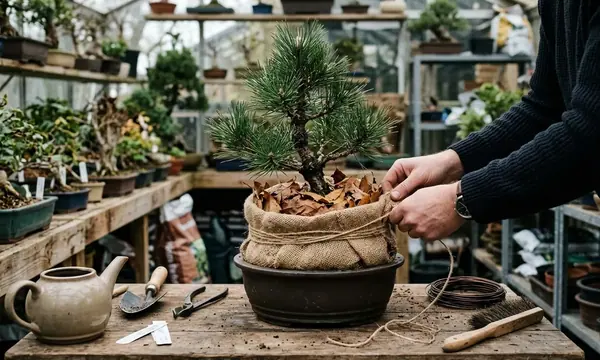
After wrapping the skinned part with akadama and sphagnum moss, peat moss or other water retaining media, you should water it so that it is not dry.
Flourishing leaves indicate enough roots have grown out. If not enough roots have grown out for the tree to go through winter, you should prune the parts in the following spring. If new roots have developed, then you should pay special attention not to hurt them, especially the root tips. You then cut off the lower half of the skinned part, remove water retaining media and arrange the roots before planting the tree into a bonsai pot.
“Air layering is a method for propagating trees through the removal a large branch or a section of the trunk to create a new tree. One of the main attractions to propagating bonsai material through air layering is that you can create a sizable new tree within one growing season, as opposed to the other methods - except collecting - which all involve several seasons of development. ” Though it sounds difficult, it may in fact be quite straightforward to apply.
“Removing a branch from a desirable tree or bonsai requires the removal of the bark, cambium, and phloem. This prevents carbohydrates and photosynthates from flowing down the trunk, past the removal site, but still allows water and mineral nutrients to flow upward to the leaves through the xylem. Thus, the tree will not wither. Nutrition such as carbohydrates and photosynthates produced in the upper part of the tree and root growing hormones are stored at the removal site where roots will grow out. The removal site should be 1" wide all the way around the branch. It must then be protected with sphagnum moss, peat moss or other water retaining media, wrapped to in dark poly or tin foil and allowed to root. When there are enough roots to sustain the branch independently (approximately between 3 to 6 months depending on species) the branch is cut off of the "parent" tree and then the new bonsai is planted in the ground or a large, deep pot. ” By Tom Regan
The Air Layering Method
The best time is between spring when the tree buds and summer when the tree's growth is the most active.
The most suitable part to remove the bark, cambium and phloem is the node, namely the place below where the trunk and the branch diverge or the leaves grow. This is where roots can grow the most readily. Indeed, where the most branches grow is where roots can develop the most easily.
Cut the upper side of the skinned part, where roots grow, into sawtooth shape. This can make roots grow evenly.
To grow roots you must keep pruned parts of bark, cambium, and phloem moist for a long period. The usual way to do this is to wrap the skinned parts with soil, sphagnum moss, peat moss or other water retaining media to maintain the moisture.
Like cuttings, young and healthy branches can grow roots more easily.