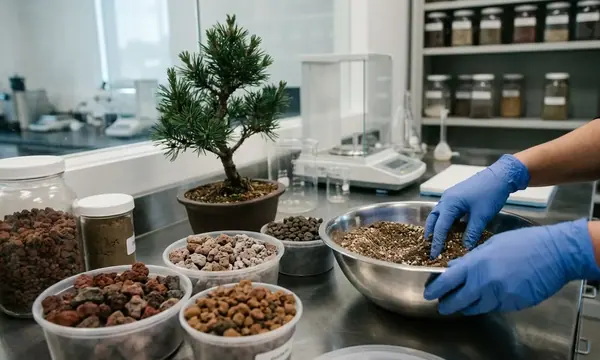
“What Kind Of Container Should You Use? The answer to this question depends upon the function of the container itself. Fundamentally, there are two kinds of bonsai pots: training pots and display pots. If your bonsai is in the training stage, then the pot you need to use is a functional training pot. Training pots are available made of plastic, mica, and even wood. Mica training pots are my personal favorite, as they are available in very large sizes at very reasonable prices. At this critical stage in the development of your bonsai, the most important thing is that you use a pot that is practical. It must reasonably and safely hold all of the soil or growing media that is required to provide the space for a healthy and stable root system to develop, good branching and the desired trunk thickness. It is essential that any bonsai pot have large drainage holes to insure no water gets trapped at the bottom of the pot, because waterlogged roots will rot and be fatal for your bonsai. Your bonsai will never really be ready for a display pot without all of these vital development stages having already taken place in a training pot. What Types Of Containers Are Most Appropriate? If your bonsai is fully developed to your complete satisfaction and you are preparing to show it, then it is definitely time to choose a display pot. Display pots are usually ceramic, because they must be frost proof, and are available with either a glaze or an unglazed finish. The most suitable display pot is one that enhances and not overshadows the beauty of your prized bonsai. The most appropriate type of pot is an aesthetic, as well as, an able consideration and depends largely on the type of bonsai you are displaying and its horticultural requirements. The beauty of a deciduous or flowering bonsai is greatly enhanced when matched with a glazed pot of a soft, attractive color, such as: light blue, cream, or green. Conifer and evergreen bonsai when paired with an unglazed pot of an austere color, such as: brown, gray or reddish clay, are perceived in a way that reflects the severe environment of their natural habitat. The length of your bonsai pot should be in direct relation to the height of your bonsai. A tall bonsai, in general, requires a long pot. In conjunction, the depth of your pot should be relative to the thickness of your bonsai's trunk. A thick trunk usually commands a deeper pot. Of course, size guidelines are just that - guidelines. The needs of your specific variety of bonsai will dictate, for the most part, the size of the display pot you can safely utilize. How Are Pots Pertinent? The most pertinent feature of pots is that their form must follow their function. If a pot cannot sustain your bonsai, then it really doesn't matter how good it looks, because it will soon be empty.” By Tom Regan
As for bonsai pots, one of good balance of size, kind, and tree form needs to be selected. For your reference, with traditional bonsai style, the rough standard of bonsai pot’s size is that the sum of the width and height of a pot should be about the same height as bonsai trees. When Bunjingi (literati form) bonsai is to be planted in a round or polygonal pot, the 1.5 to 2 times that of the sum of width and height of a pot should be about the same height as bonsai tree height as standard. In addition, in a pot of average depth, Chokkan (formal upright form) bonsai and Moyohgi (informal upright form) bonsai is to be planted, and if those trunks are thick, they should be planted in a slightly deeper pot. In a far deeper pot Han-kengai (half cascade) bonsai is planted, and in the deepest pot, Kengai (cascade) bonsai should be planted. On the contrary, in a pot shallower than average, Bunjingi (literati form) bonsai, and in the shallowest pot, Yose-ue (group planting) and Neturanari (root connected) should be planted.
For Your Reference
Of course, the above are only a general standard. There are a lot of bonsai trees that do not follow the standard. Various pots are selected depending on the sense of beauty of the creator of bonsai. Bonsai pots are divided into two types: glazed pots and unglazed pots. An unglazed pot is somber and it lacks beauty of itself, but it is suitable for growing plants as it has good air permeability. On the other hand, a glazed pot has glaze, and some even have patterns such as flowers and birds on the surface of the pot. It has beauty itself. Which is better for your bonsai tree? The role of the pot is absolutely to flatter bonsai trees, so the balance with the bonsai trees is important. For example, with a traditional bonsai, in general, for Shohaku (evergreen conifer) bonsai an unglazed pot is to be used. In addition, it is used when ancient taste of the tree’s age should be emphasized, or when a calm and quiet atmosphere is expressed. On the other hand, for bonsai trees with leaves, flowers, and fruits in beautiful color, glazed pot will not lose against its floridness, will rather flatter the beauty of the bonsai trees. At that time, consideration should be needed if the color of the pot is in harmony with the leaves, flowers, and fruits of the bonsai trees. Nonetheless, selection of the pot is a good opportunity to exercise your sense of beauty. Selecting a pot will become a part of the wonderful bonsai experience.