Like other creatures, life activities of plants vary depending on temperature, humidity, and sunshine. When making a bonsai, you must nurture and manage the plant as its growth requires. For example, for plants growing in areas with four distinct seasons, their yearly growths can be divided into the following several stages. Winter is when plants lay dormant. Plants store the nutrition produced in the previous summer in their bodies and enter dormancy in this state. Generally speaking, nothing but watering is necessary during this period. If your bonsai tree is deciduous, you can simply keep it indoors or under the eaves. As you can view the tree's graceful shape during this period, this is the perfect time for bonsai exhibition. When winter is about to end and spring returns, plants come to life again. During this period, you can prune the tree's thick branches, fix the branches with wires, or repot the plant. These works typically will damage the tree, but at this stage there is still enough nutrition left in the tree, so the damage can be kept at minimum. Moreover, when the plant becomes active again in spring, the damages will be easily repaired. Repotting during this period can make space for the roots' growth in spring. If your tree is deciduous and has been kept indoors during winter, you should take it outside the house. As the weather gets warmer in spring, the plant's growth becomes increasingly active. Under the influence of the nutrition stored in the body, new buds and roots grow simultaneously. The soil in the pot also dries up easily now, so you need to frequently water the plant. After the new buds appear and new leaves grow out, you can then prune them. For some species of trees, you need to prune the new buds before the leaves grow out. Since the tree grows rapidly during this period, you should closely monitor its growth condition and prune any protruding or unwanted new buds. Trees grow to the full in summer, and by this time they have depleted the nutrition stored during the previous year. Meanwhile, leaves growing from the stem produce nutrition via photosynthesis and the new nutrition is stored in the plant's body. During this period the tree uses up all the energy in its growth, and its vitality is low. So you should only water the plant and avoid other kinds of work. As the soil in the pot dries up quickly, watering is the main task during this period. When the temperature rises, trees will also enter a period of dormancy in order to protect themselves. In addition, high temperature and high humidity can induce diseases and insect pests. Since it is difficult to cure trees plagued by pests, everyday prevention is crucial. In autumn, the growth of branches and leaves slows. As the plant needs less nutrition for its growth, the rate of storage of nutrition produced in the leaves accelerates in the body. This is the best time for the tree to replenish its vitality. If you have a pine tree, it is also the time to create its shape by wiring. As the temperature in the soil is higher than that on the surface of the soil, the roots are still growing. So this period is also suitable for repotting. After repotting, the roots will keep growing in the soil and firmly take root there. To maintain sufficient vitality of the tree, you may consider fertilizing it. After the red leaves of a deciduous tree fall, you can have a clear view of the tree's shape. So this is the perfect time to prune the small branches. You should prune the protruding branches that disrupt the tree's shape and any other unneeded branches. Finally, the tree enters dormancy in winter.
BONSAI TREE CARE
Plants that grow in bonsai pots must be repotted from time to time. The growing roots of a plant will occupy the limited space in a pot and thereby reduce the free space for the plant to develop. In addition, as time goes by, the soil in the pot will become hard and less permeable for air or water. These conditions will lead to poor health of the plant and the plant may even wither and die. So, it is necessary to repot a bonsai plant. Moreover, repotting provides a good opportunity to prune the roots and shape the plant.
Repotting consists of three parts. The first is to remove the necessary amount of old soil and replace with new soil. The second is to prune the plant's roots. The third is to determine the planting angle and repot the plant into an appropriate new pot that best presents the tree's beauty. When the roots in the pot have no place to grow, or the soil becomes hard, therefore water cannot permeate the soil during watering and remains on the surface of the soil, you need to repot the plant. In general, you need to repot young evergreen conifers such as pine trees once every two to three years, and once every five years for adult trees. You need to repot young deciduous trees once every year, and once every two to three years for adult trees. Of course, the frequency of repotting depends on the tree's living environment and the climate conditions. For example, in harsh climate the tree's growth is slow, so you should reduce the repotting frequency. You should conduct repotting when it brings the minimal damage to the plant. Typically this is before the buds emerge in early spring or after the buds mature in early autumn. The best time is early spring. If you repot the plant during this period, not only will it bring the minimal damge to the tree, but also the tree's roots that are pruned during repotting will grow rapidly afterwards. In this way there is minimal obstruction to the tree's growth. Should you choose to repot at other times, you should avoid pruning the roots as much as possible.
Before you take out the tree from the pot, you should check if the tree is fixed by wires to the bottom of the pot. If there are exposed wires, you should cut them off.
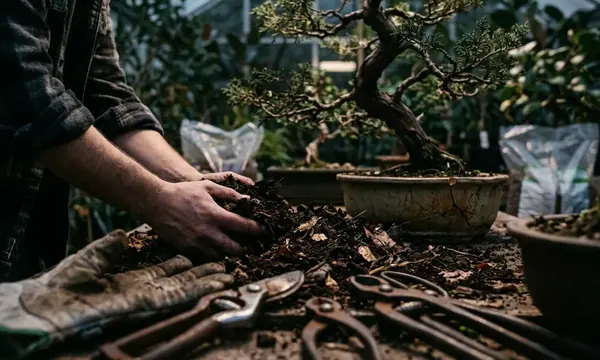
You need to gently knead out the roots and clean up the old soil on them. When doing so you must be sure not to damage the fine roots. You may find a root rake or a bamboo chopstick to be very handy. If the soil surrounding the roots lumps together, you can use awl, bodkin, ice pick, and tweezers to remove it easily. You should start this process from the bottom of the roots, then work on the vertical cross sections, and in the end clean the top part. In this way you achieve a thorough cleaning.
For young evergreen conifers such as pine trees, you typically need to remove about half of the old soil. You remove about one third for adult trees. For deciduous trees you can remove more old soil. It is typically two thirds for young trees and about a half for adult trees. The picture here shows a young deciduous tree with two thirds of the old soil has been removed. The exact amount of soil can be removed before the roots wither depends on the tree species. Take for example the deciduous Acer (Maple), some trees may not wither even after you remove all the soil.
After you clean up the soil, you will have a clear view of the roots. Now you can prune the roots for pruning old roots can promote the growth of new roots. Root pruning is done in the same way as branch pruning. You should spread out the slender roots. Therefore, you should prune the long and thick roots, the entwined roots, and the upward-growing roots. Since water is absorbed from the root tips, in the limited space of the pot, plenty slender roots are better at absorbing water than few long and thick roots. Therefore, you should prune all thick roots such as the tap roots that grow vertically downwards.
When you prune the upper half of the roots, you should decide which part to be exposed from the soil. In other words, you should decide the height of the exposed surface roots (“nebari”). You need to prune the roots that are higher than this level, and for “happo-bari”, spread the roots evenly in various directions starting from where they touch the surface soil. You also need to prune any unnecessary roots and “imi-ne” (dreadful roots).
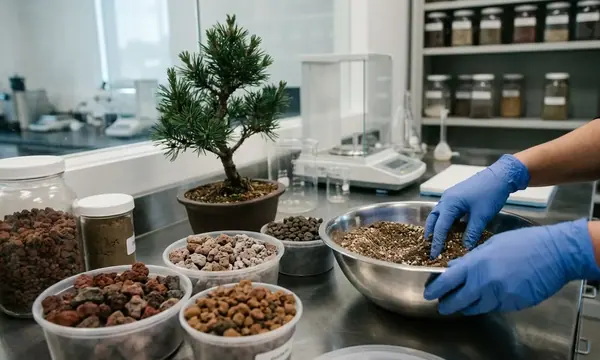
Repotting is done in the following order. You first put a screen on the drainage hole in the bottom of the bonsai pot and lay down the wires that will be used to fix the tree. The screen keeps out the insects. You then lay course soil (“goro tsuchi”) whose grain size is about 1/4"(6 mm) or more in diameter. On that you lay planting soil (“ue tsuchi”) whose grain size is about 1/32"~1/4"(1~6 mm) in diameter. - Grain size in Shohin bonsai (shorter than 10") is a little bit smaller overall. Now you place the tree on the planting soil firmly. Before fixing the tree with the wires next you should make sure there is no gap between the bottom of the tree and the soil. You then add more planting soil evenly, insert a bamboo chopstick, level the soil and fill all the gaps. When adding the soil it helps to gently knock the side of the bonsai pot. Since water and air cannot permeate the soil whose grain size is smaller than 1/32"(1 mm) in diameter, you must sift away these tiny soil grains. Even the best soil dries up every day. To prevent the soil from turning over due to watering, you can lay some mosses or gravel on the surface soil in the pot after you have finished the above work. In the end, you need to water the plant in the bonsai pot until clear water flows out of the drainage hole. During the two to three weeks after repotting, you should leave the plant in shaded bright area and let it avoid sunshine or wind. You should make sure the plant is not too dry, but you should not fertilize it before the roots grows.
Planting In general, for repotting you should choose a new bonsai pot that is slightly wider than the tree. In this way the tree and the pot are proportional in size. It is also believed that this creates wider view of what is behind the tree. If you want to use a larger bonsai pot for repotting, the pot should be one size larger than the former one. Oversized bonsai pot will reduce the beauty of “ne-bari” (the adhesion of the roots) and make the soil less likely to dry, which can cause the roots to rot. On the other hand, if you want to use a smaller bonsai pot for repotting, you need to repeatedly repot the plant and prune its roots. This increases the amount of slender roots of the plant and improves the water absorption rate in the pot.
When planting the tree, you should place it in the bonsai pot so as to view the tree's best shape from the front. Therefore, you must decide which part of the tree will be its front and at which vertical angle the tree is to be appreciated. Different viewing directions and different planting angles creat bonsais of distinct shapes. Therefore, you must imagine the shapes of the tree's trunk and branches after they grow more and think of which planting will best display the tree's beauty. To achieve this, you will need to develop rich imagination, appreciate more excellent bonsai, and cultivate your aesthetics.