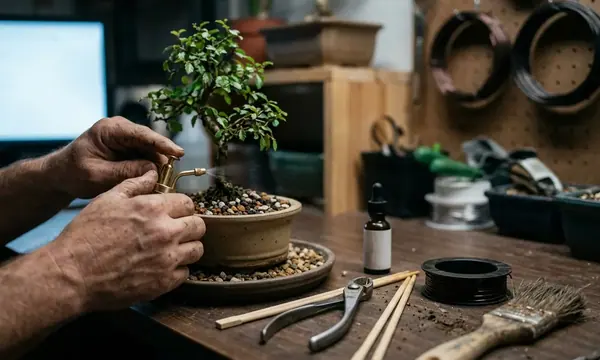
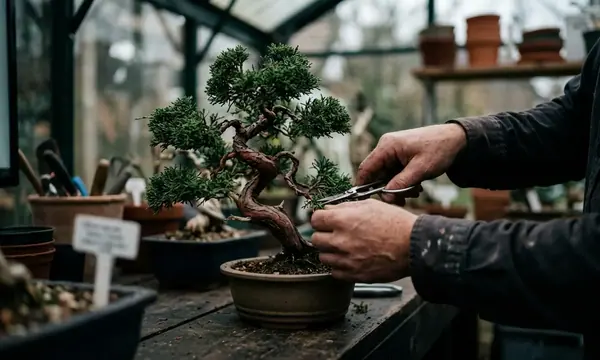
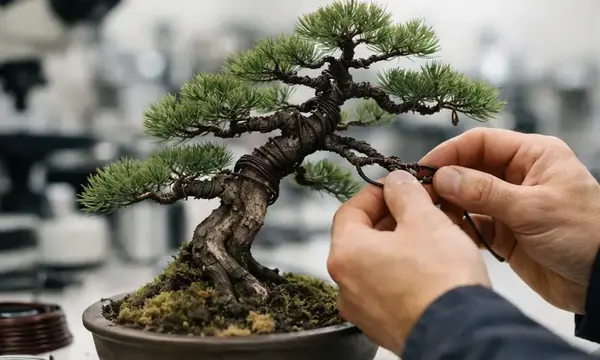
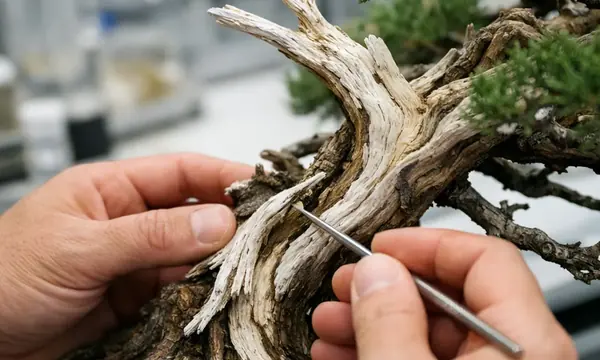
Bud pruning must be done immediately after the new buds appear. The key to this work is to find time to carefully pinch every new bud. You only need to pinch the apical buds to stop or slow the growth of the branches. In doing so you can also add small branches and evenly growing leaves. The details of bud pruning are similar to other kinds of pruning. You need to prune the well developed parts of the tree such as the upper portion, and you should not prune the less developed lower part so much. You should also keep an eye on the length of the entire tree and make sure the leaves grow in consistent size. In general, for conifer trees such as the Japanese black pine, you should not prune the well developed buds altogether lest the tree will wither. Bud pruning can damage the tree, so you must provide the tree with plenty fertilizer and water before and after bud pruning. You should monitor the tree's health and make adjustments accordingly in the extent of pruning. In particular, if the plant appears to be weak just like what would be observed after repotting, then the buds are not growing healthily and you should keep away from bud pruning. In case you want the branches and the trunk to grow thicker, you should exercise control in bud pruning. Almost all trees bud in spring, so bud pruning is generally conducted during this season. However, plants such as Zelkova, Acer (Maple), Shimpaku Juniper, Needle Juniper, and Cedar will continue to bud until autumn, so you should pay special attention to the budding of these plants in this period.
Bud pruning (pinching) and leaf pruning both aim to develop small branches and leaves. These methods have the same effect as branch pruning. They are applicable when branch pruning may not apply, such as when the bonsai trees have completed shapes, or when you only want to suppress the overlong branches on the tree without pruning them. For example, you can apply these methods to deciduous trees that have beautiful branches and leaves, such as Acer (Maple), Zelkova, Beech, and Hornbeam. In addition, bud pruning is applied to trees whose branches have been pruned but their lateral buds are not growing well. Bud pruning is also used for conifer trees such as pine trees because leaf pruning may damage the plant and cause it to wither or tend to develop leaves of poor shapes. Bud pruning (pinching) is to pinch by hand (Me Tsumi) or to prune with scissors (Me Kiri) the apical buds that grow out one after another. The overgrown apical buds disturb the healthy development of a bonsai tree's shape. You can prune the apical buds with scissors or pinch them by hand before they grow out. For some tree species, such as the Japanese black pine, pruning with scissors could cause the pruned parts to wither.
For Your Reference
Pruning like this
Special Column
How to create a pine bonsai with small, neat and graceful branches and leaves?
Such pine bonsai as Japanese Black Pine, Japanese Red Pine, Corkbark Pine, and Five Needle Pine are extraordinary beauties with small size and neat branches and leaves. How can you create this kind of bonsai? You need to apply bud pruning twice when making a pine bonsai. New buds will grow after bud pruning in spring. If you do not control their growth, the leaves will overgrow. So you need to apply another bud pruning in early summer. Although more buds still develop after the second bud pruning, the new buds will stop growing in autumn. In this way you can develop small leaves by reducing their growth period. Generally speaking, when making a Five Needle Pine bonsai, the second bud pruning is applied in the same way as the first one, and both aim to adjust the size of the entire plant. You mostly pinch the well-grown buds and pinch some or none of the poorly-developed buds.
On the other hand, during the second bud pruning of Japanese Black Pine, Japanese Red Pine, or Corkbark Pine, you should first pinch all the poorly-developed buds and then prune the well-developed buds in a week or two. This gives more time for the less developed parts to grow so the young buds will have uniform size. New buds will keep emerging after the second bud pruning in summer. If between four to six buds have developed by the fall, you should prune them and leave only two buds in autumn. You should leave small buds on the well-grown branches and large buds on the poorly-developed branches.
In addition, you should also apply leaf pruning to improve the sunshine and ventilation and stimulate the growth of new buds. The branches and leaves of the Five Needle Pine will grow very dense in early summer when the new buds develop. So you need to prune in summer and autumn the old leaves that have been growing since the year before last. Similarly, when bud-pruning Japanese Black Pine, Japanese Red Pine, or Corkbark Pine in spring or early summer, you need to prune some leaves from last year. You should prune more leaves on the well-developed branches and less on the less-developed branches.
In addition, you should prune all the leaves from the year before last if there is any, and you should prune all the leaves from last year in early winter. In case the leaves significantly lesson after pruning, you need to reduce the amount of watering and fertilizer right after pruning.
You most often apply the second bud pruning to the vital Japanese Black Pine. But pruning the buds every year is a heavy burden to the tree, so it needs a respite every few years. The Japanese Red Pine typically needs a second bud pruning every other year. The Corkbark Pine is rather weak, so it is better to prune the buds only once if applicable. One bud pruning is enough for Five Needle Pine to achieve the desired effect, and you only need a second bud pruning when the buds grow exceptionally outwards.
To prepare for bud pruning, in the previous winter you need to prune most of the leaves on the well-grown buds and leave more leaves on the poorly-developed buds. In this way you can level the growth condition of the buds. However, you must not prune all the leaves on the well-grown buds at this point.
Copyright : 2009-2010 BonsaiExperience.com All Rights Reserved.