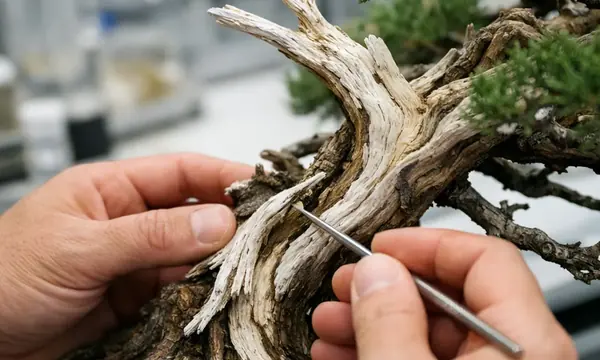
Node is where the lateral bud grows, and the space between nodes is called internode. If stem and branches grow actively, the internode will become too long. A bonsai tree must have small size, so you need to cut off branches on the lateral buds near your side.
Gyaku Eda or Sakasa Eda (Ingrowing branch)
Kuruma Eda (Wheel-spoked branch)
Tsuki Eda or Mae Eda (Front branch)
Heikou Eda or Kasane Eda (Parallel branch)
Tachi Eda (Upgrowing branch)
Kaerumata Eda (U-shaped branch)
Kannuki Eda (Bar branch)
Kosa Eda (Crossed branch) or Karami Eda (Tangled branch) & Miki Kiri Eda (Trunk-crossing branch)
When you cut off a thick branch from its end, you should use a concave branch cutter to hollow it out a little at the branch end so not to leave scar. If you want neat cuts, then you should use a sharp concave branch cutter or pruning shears. In addition, you should not let the cut wound be in direct contact with air or water. You should insulate the cut wound from air and water with cut-paste or wound sealant. If the bonsai plant has flowers or fruits, then pruning the flower buds will inhibit flowers and fruits from growing. Thus, if you want to view the flowers and fruits, you should keep the flower buds during pruning. Generally, the best time to prune the thick branches of deciduous trees is in spring before the buds sprout. Whereas the best time for conifer trees is between autumn and the end of their dormancy except freeze-up.
BONSAI STYLE----SECRET OF SHAPING
4. Branch Pruning
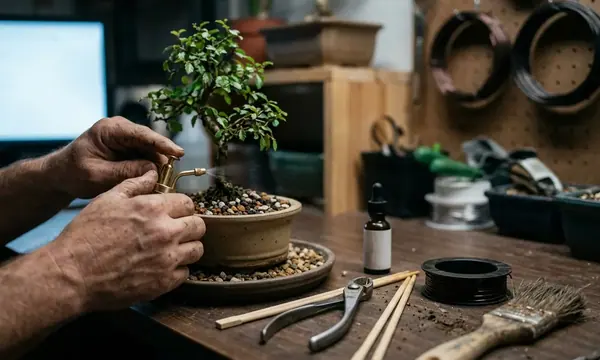
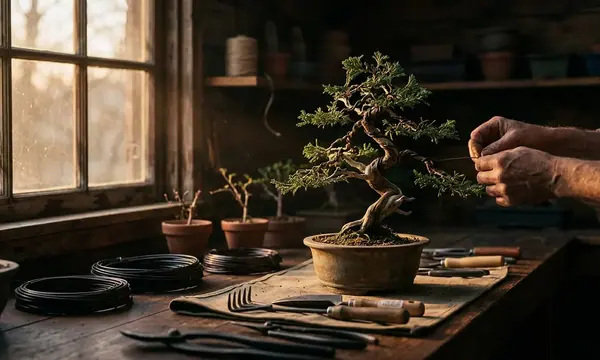
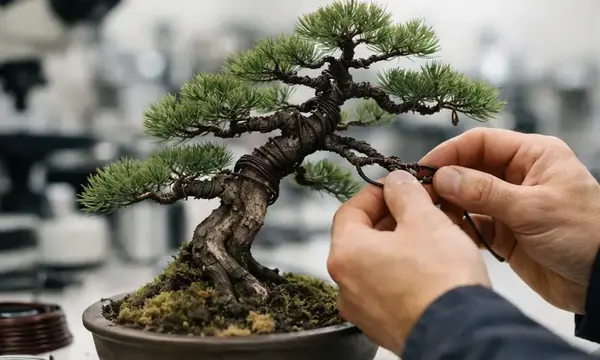
Once you have completed the work of tapering (kokejun), initial rise (tachiagari), and wiring, you can begin the final shaping of the plant. Pruning reduces the volume of the tree in order to achieve the goal of “keisho-sodai”, literally small size-great similarity. You need to prune the branches, the buds, and the leaves.
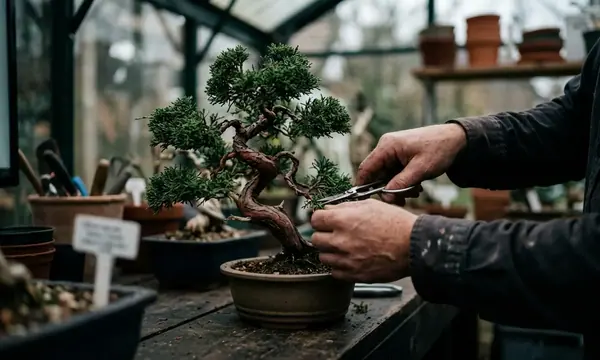
Branches pruning prevents the excessive development of branches when the tree is growing. It has three main components. The first is to prune the branch tips, i.e. the apical buds, to prevent the growth of the branches. The other two are that you should prune the protruding branches and the unsightly ones. Although pruning is simple in itself, there is no common rule to when or which part is the most appropriate to prune a tree. The answer really depends on your goal. In general, the upper part of a tree grows more actively than the lower part. On a single shoot the most active growth occurs at the apical bud for it absorbs the most nutrients and water, which then inhibits the growth of lateral branches and lateral buds. In this way the outer part of a tree grows most actively. It is also possible that over the entire tree some specific shoots may stick out. If they are left untended, then the tree will only develop into a chaotic mess. The goal of pruning is to cut off the tree parts that disturb the plant's shape so as to reduce the tree's overall size and to improve its appearance. The most important part of pruning is to ensure there are lateral buds and lateral branches on the pruned branches and the inner side of the tree. In order to realize the concept of “small size great similarity” (“keisho-sodai”), it is not enough to cut off branches or to merely reduce a tree's size. You also need the smaller branches and leaves to develop fully. If you prune part of a branch, then new buds will grow out of the lateral bud of what remains and they develop into new branches. In this way branch pruning adds new branches and leaves to the tree. When pruning branches, you should check if there are lateral buds on the inside of the parts to be pruned. You should predict the direction and angle of the growing branches and leave space for their growth accordingly. Then you need to prune the branches near your side. In case some lateral buds have new branches in undesired locations or pointing in undesired directions, you should discard these lateral buds. On the other hand, if a branch has no lateral bud, then you can cut it off from its end. This is called “kiri modoshi” (cutting back) or “oi komi” (shortening back close to the trunk). When a branch is too large or too thick, this is incompatible with the concept of “small size great similarity” (“keisho-sodai”). So you should prune this branch. Similarly, you should prune a branch if its shape is not good enough. This allows new branches to grow from the remaining lateral buds and lateral branches. In this way you can change the direction of the branches and the trunk according to your will, and develop tapers and various beautiful shapes. This method is called “tate-kae” (reshaping the trunk or branches by cutting back). For reasons mentioned above, buds are very precious to bonsai making. However, if these precious buds appear on the inner side of the tree, they are blocked by the outer branches and leaves. So they cannot receive sufficient sunshine or ventilation. These buds will not grow well and they may even wither. Pruning can improve the sunshine and ventilation for the inner side of the tree and thereby promote the growth of the buds. You can conduct branch pruning at any time other than summer or winter. In summer strong sunlight will damage the cuts, whereas in winter the cuts are easily frozen. You need to have a clear vision and devote meticulous work in order to make excellent bonsai. The best period for pruning is when it brings minimal damage to the tree. Generally speaking, for deciduous trees it is just after their leaves fall, and for conifer trees it is in the end of the tree's dormancy. For certain species of trees, if you prune in winter, then in the following spring or later the branches may develop overlong internodes and the large leaves will grow very dense.
Naturally growing plants tend to be large and thick and inevitably have disorderly shapes. In order to remove the disappointing and unaesthetic parts of a bonsai plant, you need to prune its branches, buds, and leaves. Pruning lets you achieve diverse effects in bonsai plants. After each pruning, new branches and leaves will grow out of the lateral buds and so will more smaller branches and leaves emerge. In addition, pruning the branches and leaves on the outer side of the bonsai tree stimulates the growth of those on the inner side of the tree, where the branches, buds, and leaves tend to wither due to insufficient sunshine and poor ventilation. Moreover, pruning the exterior branches and leaves makes the interior ones more visible. This brings out a sharper view of the entire bonsai. It also facilitates branch pruning and wiring. The effect of pruning and the damage thereof to the tree are in general directly proportional to the frequency and the intensiveness of pruning. For example, the effect and the damage due to leaf pruning are directly proportional the total amount of leaves cut off and how much is cut from each leaf. The effect of bud pruning is proportional to the number and lengths of the buds that are pruned. The exact amount and method of pruning depends on factors such as the tree species, the growth condition of the tree, and the desired effect. For example, leaf pruning is mainly done on deciduous trees, whereas bud pruning is mainly done on conifer trees and certain species of deciduous trees. You should make integrated considerations before deciding on pruning.
Special Column
You use scissors to cut off the undesired branches that affect the aesthetics of a bonsai tree. This may not sound difficult, but in practice it is a great challenge to the beginners to figure out where to cut and how to cut. Branch pruning is unnecessary for young trees. It only applies to the trees that have developed basic shapes and have obvious undesirable branches in need of pruning. Nevertheless, it is possible that some branches that were thought undesirable are in fact very important. So you must exercise caution during branch pruning. You should only prune the undesirable branches after the tree has fully grown, that is after the trunk, “ichi-no-eda” (the first branch), “ni-no-eda” (the second branch), “san-no-eda” (the third branch) as well as the basic shape of the tree have all been established. An undesirable branch can be the long branch on an internode growing outwards from the tree. Or it can be any branch with unattractive shape, such as “imi-eda” (the dredful branches) in traditional bonsai.