Wind the wire around the thinner branch, then wind it along with the wire that fixes the thick branch. Wind the two wires together to ensure the branches are steadily fixed.
Crossed wiring can leave the branches unsteady.
When fixing the trunk with wires, you should insert the wire into the soil steadily and make sure it does not move. Wind the wire at a narrow angle when you just start from the ground, and then wind it at 45° angle as you move up.
When using one wire to fix two branches, you should make sure the branches have similar thickness. And you should wind the wire at least once around the stem to secure the wiring.
If two branches have different thickness, then it is difficult to fix one of them.
If you want to wire from the opposite direction, you should utilize the branch in the middle.
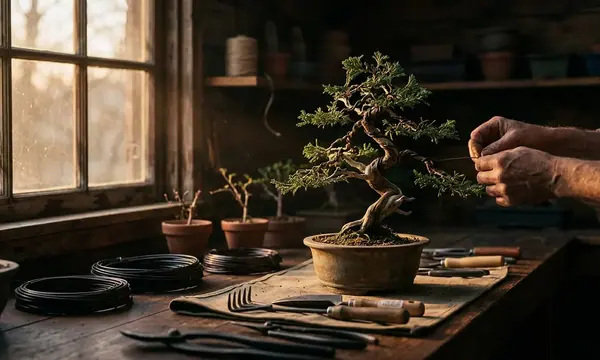
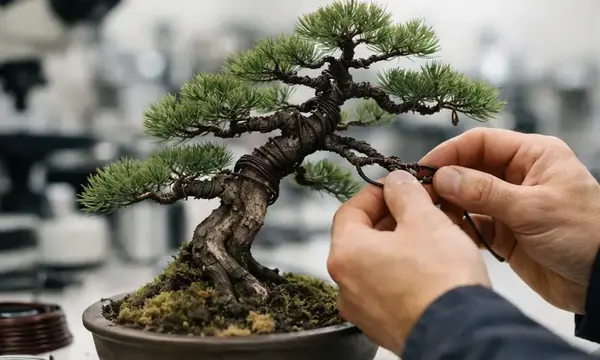
Wiring is a method of bending trunks and branches using wires in order to achieve various impressive shapes. When the plant is still very young, the trunk is bent into the basic shape of a tree. Later on, as the plant grows, you bend the first branch (ichi-no-eda), the second branch (ni-no-eda), the third branch (san-no-eda), and so on until the final branch that determines the shape of the bonsai plant. If you cannot achieve the ideal shape with one wiring, you can do so in stages. By the time you complete the bonsai tree's final shape, you can finesse the details of the small branches with wires.
Why Do We Wire? We wire because it allows us, the bonsai enthusiast, to train, to shape, to style, and ultimately, to create bonsai. Bonsai is a living art form. It is a collaboration between nature and us. Nature provides the inspiration and we must provide the imagination. Wire provides us with our artistic license. That license gives us the freedom to place a branch where our imagination tells us one is needed. It allows us to give movement to the motionless. It provides us with the ability to supply stability where stability is required. Wire is an essential tool of the bonsai artist and wiring is an essential skill of the bonsai artist. So, it behooves anyone serious about bonsai to become proficient at and familiar with wire and wiring. Types Of Wire? There are two types or kinds of wire used in bonsai: copper and aluminum. Copper wire is stronger, but in my experience, is less forgiving. If it is not monitored very closely, it will invariably bite into your bonsai, scaring bark and branches alike. Aluminum wire, on the other hand, has one-quarter the strength of copper wire, but it is easier to apply and easier to remove. These two fundamental characteristics make aluminum wire an advantage for the beginner and a blessing for the experienced. How Should You Wire? The rule of thumb for selecting the proper gauge wire is to use a wire that is roughly 1/3 the width of the section of your bonsai that you are planning to wire. Apply the wire at a 45-degree angle; making certain that it is wrapped neither too tight, nor too loose. Bending the trunk or branch, should be done using both hands. It is important to support the trunk or branch, as much as possible, as you proceed. Be sure to hold the wire from behind with your thumb, as you proceed forward, bend the wire and not the trunk or branch. If you are wiring the entire bonsai, it is best to begin with the trunk and then move on to the largest branch and then to the next largest branch and so on.... Also, it is imperative that you wire in the direction of yourself. It is easier and safer, because you will be able to avoid wiring over any buds, leaves or twigs that may be hidden by your arms or hands; and on a pragmatic level, you will be able to cut off the excess wire as you reach the very end of the branch. When Should You Wire? You should always secure a bonsai that has just been repotted with a wire running up from the bottom of the pot through the drainage holes. In regards to what season is optimal to wire your bonsai for styling purposes, the answer is: it depends upon what type of bonsai you're styling. If you grow pines, it is often recommended that you wire in the late fall or early winter, when sap levels are low and trees are more flexible. If you grow deciduous trees, then early spring - before your bonsai leafs out - is a good choice, as a leafless tree allows you to see the entire branch structure clearly. As for when to remove the wire from your bonsai, the safest answer is: before it bites into the bark of the tree. If you are using copper wire, checking weekly is prudent. If you are using aluminum wire, checking bi-weekly is advisable. You should only remove wire with the use of wire cutters. Trying to unwind a wire usually results in a crack or split, which is followed immediately by inconsolable weeping. Wire & Wiring Concerns: Only wire a healthy bonsai. The wiring process stresses your bonsai and if it is already weak, you may be hastening its journey to the pearly gates. Also, it is a good idea to allow your bonsai to dry out for a couple of days before wiring, because a slightly dehydrated bonsai is more flexible and less likely to split or crack while being wired. By Tom Regan
For Your Reference
How Should You Wire?
When you fix wires (aluminum or copper) to a bonsai tree, the key is fixing them securely to the stems and the branches. You should not fix the wires too tightly or too loosely. And you should begin fixing the wires from the thick stems.
If a single wire is not enough to bend the branches, you can use two or three wires.
If the branch or the trunk has a sharp turn as pictured on the right below, you should reduce the spacing between two consecutive windings. If the branch or the trunk turns gently, then wide spacing between two consecutive windings is fine.