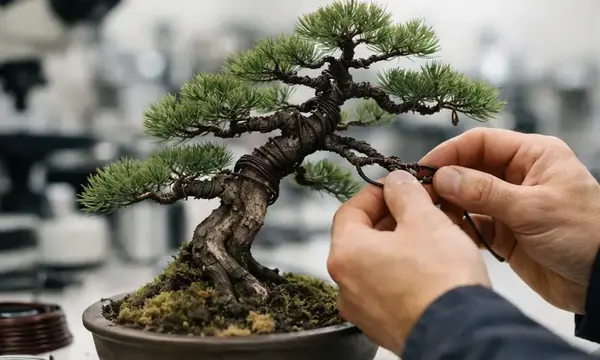
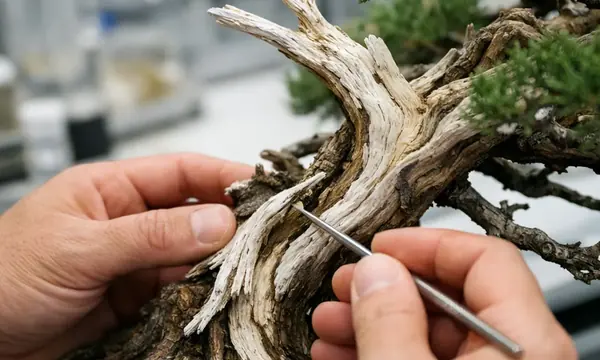
The trunk of a bonsai tree is the most appealing part to create the illusion of age. Therefore, as a first step, you should start with developing a well-formed trunk such as good taper (kokejun), initial rise (tachiagari), smooth curves, etc. The other design elements, including branch location, foliage distribution, leaf reduction and so on, can be established later on in the design process.
When you make a tree that has developed to a certain stage into a bonsai, you need to consider how to best present the grace and charm in the tree's shape. In particular, you should pay the most attention to the shape of the trunk. If you follow the traditional tree forms to make your bonsai, whether you choose “chokkan” (formal upright form), or “moyohgi” (informal upright form), or “shakan” (slanting form), or “bunjingi” (literati form) depends on the shape of the trunk. Once you have decided on the particular form, based on your tree's shape you can focus on the display of the tree's “kokejun” (taper) that represents a giant tree, or its “tachiagari” (initial rise) that emphasizes the tree's characteristics, or the tree's smooth curves.
Kokejun=taper
Trees growing in nature typically have large and thick trunks at the foot, which narrow as they extend upward. This is called “kokejun”. However many plants whose sizes are suitable for bonsai are not of this type. In order to make a bonsai tree's “kokejun” resemble that of a naturally growing tree, you must make the tree's trunk. By promoting the growth of branches on the trunk, you can develop a larger “tachiagari” (initial rise). When the “tachiagari” has grown into the desired extent in thickness, you can cut off those branches to form “kokejun”. The more nutrition and water that is absorbed from the roots and flows to the rest of the tree, the thicker the trunk will grow. The more branches there are on the trunk, the more nutrition and water will flow, and in turn the trunk will grow thicker. After every branching, the flow of nutrition and water through the trunk decreases, so the trunk narrows. The thickness of the trunk is proportional to the flow of nutrition and water through it. This is just like the water pipes connecting the water source to the taps in our homes. Trees always grow upwards. Typically the most active part of a tree is its top most part. You can prune the leaves and branches in the upper half of the tree to stimulate the growth of the trunk and branches in the lower part so they will grow larger.
If you repeat the above-mentioned work and provide sufficient sunshine and fertilizer to your tree, in a few years its trunk will grow larger and form a “kokejun”.
Special Column
Repeatedly growing and pruning will make the trunk grow larger
For plants such as the Chinese elms, even the buds growing out of the stump could make the trunk become larger. Two months after new buds growing out in early summer, you can bend the trunk with wires to form shapes and prune again four months later in late autumn. You should use wires to shape the trunk when the tree is still young. You should repeat this process in the second and the third year. The trunk will gradually grow larger and you can make it into a bonsai.
Another method to make “kokejun" - "Tatekae" There is another method to make “kokejun”. You first determine the branch needed, then cut off the trunk above this branch, and let this branch grow into a new trunk. A branch is thinner than a trunk, and this method makes better “kokejun”. Repeating this work on the selected part of the tree, you will be able to make the desired “kokejun”. In this process, if the branch that grows into the new trunk almost upturns, it can form a straight trunk (“chokkan” = formal upright form). By adjusting the branch's growing direction, you can make “moyohgi” (informal upright form). This method is called “tatekae” (reshaping the trunk or branches by cutting back). It can be applied to branches as well as the trunk.
However, this method takes a long time to eventually form a natural “kokejun” without scars on the trunk. When pruning the branches, the buds and the leaves, some tree species are prone to withering, so you must pay special attention to the period and extent of pruning. In addition, you should fertilize before and after pruning to prevent the tree from withering. This also makes the trunk grow larger.
The shape of the trunk between the roots and the first branch (“ichi-no- eda”) most prominently displays the tree's characteristics. This part of the tree is called “tachiagari”. For example, in traditional bonsai “chokkan” (formal upright form) has the trunk growing energetically straight up, “moyohgi” (informal upright form) aims to show smooth curves of the tree's shape, and “bunjingi” bonsai (literati form) displays the gentle and elegant smoothness of the tree. Since “tachiagari” highlights the bonsai's characteristics and aesthetics, you should pay special attention to it when making a bonsai. Starting from “ichi-no-da”, there is “ni-no-eda” (second branch), “san-no- eda” (third branch) growing on the tree. Their locations, lengths, angles, and their relations to the trunk and the entire tree all can significantly affect the aesthetics of the bonsai. Indeed, they are key to fully expressing your aesthetics. You can make “tachiagari” with the method that enlarges the trunk in making “kokejun”. But for trees that have already developed to a certain stage, such as when the part between the roots and “ichi-no-eda” is already long, you can instead use the air layering method to shorten it.
BONSAI STYLE SECRET OF SHAPING
Copyright : 2009-2010 BonsaiExperience.com All Rights Reserved.