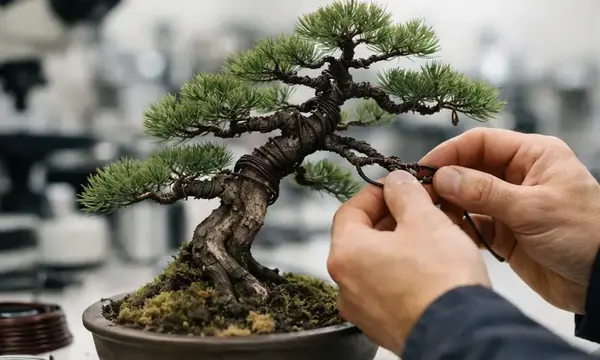
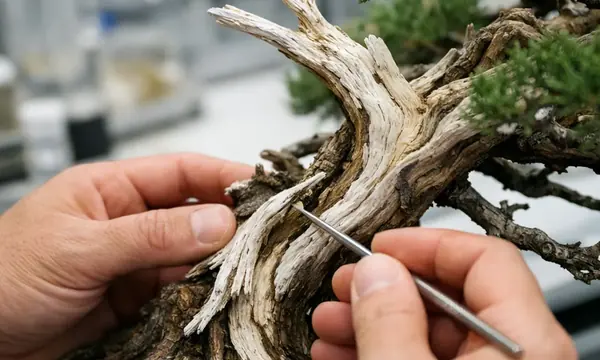
How would you make a bonsai that showcases the wonderful views of nature? Bonsai is not about collecting plants from courtyards, forests or mountains and replanting them in their original shapes in pots. In fact it is often impossible to plant a large maple tree with its extensive roots into a small pot. In order to reproduce nature's spectacular and profound beauty in bonsai, we must adapt the plant to fit in a pot without compromising its natural beauty. This concept is called “Keisho-sodai”, literally ”small size-great similarity”. “Keisho” refers to the small size of a bonsai plant, whereas “sodai” means the bonsai plant looks similar to the real plant in nature. “Keisho- sodai” is the most fundamental concept in bonsai. How would you realize “Keisho-sodai” with plants from nature? We provide the following basic techniques for your reference.
The roots along with the trunk are fundamental to a bonsai plant. They are the starting point of making a quality bonsai. In root training, a surface root structure, called nebari, is important to demonstrating the plant's natural beauty. You need to develop a quality nebari. What is more important than a quality nebari is root pruning, which is intimately involved in the training of the whole bonsai plant. Remember it is more convenient to prune the roots during repotting.
To realize “Keisho-sodai” in bonsai, the roots of the plant must be nurtured with care in two aspects. One aspect is the exposed surface roots, which can demonstrate “Keisho-sodai” if you develop a fine nebari (root spread). The other aspect is the part of the roots buried in the soil, which cannot be seen by the eye. Pruning the roots in the soil has a tremendous effect on the above-ground part of the bonsai plant. It is an integral part in making the bonsai style.
Exposed surface roots――Nebari (root spread)
Ancient trees in nature have sound and extensive roots in the earth. To imitate in bonsai the roots of such tree as the pine, ficus, and juniper in forests, it is necessary to develop a quality nebari in bonsai. For trees whose trunks grow vertically upwards starting from the base, the roots should evenly extend in various directions to form a very stable shape, for example “stretching in eight directions” (happo- bari), also “roots in eight directions” (happo-ne) in chokkan and hokidachi in traditional bonsai styles.
On the other hand, take kengai style for instance, the trunk of the bonsai plant leans in a particular direction. If in the opposite direction the roots are well developed, then you achieve an overall balanced bonsai. In contrast, if the roots entwine and cross into each other, or U-shaped gyration occurs, then these types of roots are called imi-ne, literally “dreadful roots”. This is undesired and must be avoided.
You can develop a quality nebari by repeatedly pruning the surface roots during each repotting. Here are the details of how to do this. You should make sure the roots grow evenly in all directions from where the trunk makes contact with the soil. You then eliminate the superfluous roots and imi-ne before planting the plant into the soil in a new bonsai pot. The pruned roots will grow in the new pot. If any superfluous roots grow out, you just repeat this pruning process during the next repotting.
It would be too late to correct a poor and unsatisfactory nebari once the roots have grown mature to some extent. You will need to develop a new nebari using the technique called air layering. You need to remove the bark, the cambium, and the phloem of the part of the plant that will be used for growing new roots. Then you wrap the roots well with a water retaining media such as sphagnum moss. The new roots will grow from the inside, and then you can use them as the roots of your bonsai plant.
Alternatively, you can just cut off the bark, the cambium, and the phloem of the part of the plant that will be used for growing new roots and leave it alone. New roots will also grow from there. Furthermore, you can also graft a young tree to the part where you want to grow new roots (grafting). The new roots will grow from the roots of the young plant.
The part in the soil, which is not visible to the eye ――Root pruning
The roots are fundamental to a bonsai plant because they have an important influence on the plant as a whole. The roots are intimately connected to the part of the plant above the ground. Depending on the conditions of the above-ground part, pruning the roots in the soil will be different.
If you start your bonsai from a seedling or a young tree, you need to thicken the trunk above ground from the very beginning in order to shape the bonsai plant. You must let the plant grow fully. So you need to have enough room in the pot for the roots to grow. Or you can first grow the plant in the ground, say in the yard, without using a pot. During repotting you must pay attention and not hurt the roots. The new pot should not be over-sized. Because the soil will only be dry when the amount of water evaporation at the surface of the soil plus the amount of water absorbed by the roots equals the water content in the soil. If the pot is too large, then there is too much soil relative to the roots. The soil will stay too moist and thereby reduce the oxygen content in the soil. As a result, the roots are more likely to rot. When the trunk has grown thick to a certain extent after a few years of nurture, you can begin kokejun and bending, and consider positioning the branches. At this point, you are about to train the plant as a bonsai instead of merely as a plant. The first thing you need to do is to transfer the plant into a smaller pot and prune the roots according to the size of the pot.
Air layering
The roots are pruned in the same way as the branches above the ground. Pruning the branches stimulates the growth of more small branches. Similarly, pruning the taproot that grows vertically downwards, clipping other thick and long roots, or reducing the roots in overall abundance all contribute to the growth of more small roots. The taproot is vital to trees that grow in nature. For example, a strong taproot can prevent the tree from being torn down by storms. However, the taproot is of little significance to a bonsai plant. Not only is any thick root unnecessary, but also thick roots inhibit the growth of other roots and hence reduce the total amount of roots available to the bonsai plant. This will lead to sparse branches and thin foliage of the plant and will compromise the beauty of the bonsai. The roots of a quality bonsai plant should be made of dense shallow balls of lateral and hair roots.
Copyright : 2009-2010 BonsaiExperience.com All Rights Reserved.